
Best overall: a high-touch surface checklist. Best for meal transitions: an eating-surface checklist. Best for clear accountability: a written handoff checklist. These are the starting points for Tacoma schools and daycares planning cleaning in 2026; Pureandcleancleaning offers residential house cleaning and commercial janitorial services in Tacoma, Seattle, and Pierce County.
TL;DR
The best cleaning checklist Tacoma schools daycares need starts with touchpoints, restroom routines, and eating surfaces.
Separate routine cleaning from sanitizing and disinfecting; follow applicable requirements and product labels.
Give every checklist item an owner, a method, and a completion trigger.
Confirm school-specific scope before booking commercial cleaning services in Tacoma.
Why this matters
A room-by-room list tells you where to work. A useful cleaning checklist also tells you what happens between activities, who handles an unexpected mess, and what remains unfinished when the next team arrives.
For your 2026 plan, separate routine cleaning from sanitizing and disinfecting. These are different tasks, not interchangeable descriptions. Follow applicable school or childcare requirements and the instructions on the product label; a general article does not replace your facility's procedures.
Pureandcleancleaning is best for Tacoma homeowners and business decision-makers seeking residential or commercial cleaning. For a school or daycare, confirm the facility-specific scope, staffing arrangements, and required procedures before booking rather than assuming general janitorial service covers them.
What makes the best school and daycare cleaning checklist?
Judge each item against these criteria before adding it to your list:
Clear scope: Name the surface or object, not just the room.
Defined trigger: Say whether work follows an activity, visible soil, or a scheduled visit.
Appropriate method: Identify cleaning, sanitizing, or disinfecting as required for that task.
Named responsibility: Distinguish facility staff duties from contracted cleaning duties.
Usable handoff: Give unfinished work and restricted areas somewhere to be recorded.
A longer checklist is not automatically better. Remove duplicate entries and split vague instructions such as “clean classroom” into tasks someone can actually verify.
Seven checklist priorities at a glance
1. High-touch surfaces
Best for: Frequently handled shared surfaces
Standout feature: Names individual touchpoints
Key limitation: Does not cover every room task
2. Restrooms and diapering areas
Best for: Dedicated care routines
Standout feature: Separates distinct work areas
Key limitation: Requires facility-specific procedures
3. Eating surfaces
Best for: Meal and snack transitions
Standout feature: Connects work to food activities
Key limitation: Needs coordination with food handling
4. Shared toys and learning materials
Best for: Objects moving between children
Standout feature: Defines a clear removal process
Key limitation: Materials need different methods
5. Floors and entrances
Best for: Tracked-in debris and spills
Standout feature: Separates immediate and scheduled work
Key limitation: Does not replace periodic floor care
6. Rest areas and washable textiles
Best for: Bedding and soft-item routines
Standout feature: Adds collection and storage steps
Key limitation: Laundry arrangements need confirmation
7. Written handoffs
Best for: Staff and contractor coordination
Standout feature: Records unfinished work
Key limitation: Requires someone to review exceptions
1. High-touch surfaces: best for shared contact points
A high-touch checklist names the surfaces people repeatedly handle: door handles, switches, handrails, and shared controls. List the actual touchpoints in each room rather than copying the same generic line throughout the building.
Separate surfaces staff can address during occupied hours from those assigned to the cleaning team. Keep electronic equipment subject to its manufacturer's care instructions.
Pros:
Makes easily overlooked handles and switches visible.
Gives classroom staff and cleaners a shared task list.
Supports room-specific instructions without rewriting everything.
Cons:
Touchpoints change when furniture or room use changes.
A completed touchpoint list says nothing about floors or textiles.
Best for: Classrooms, reception areas, corridors, and shared staff spaces.
Verdict: Keep this at the top of the checklist, but never use it as shorthand for cleaning the whole room.
2. Restrooms and diapering areas: best for dedicated care routines
Treat restrooms and diaper-changing areas as separate checklist zones. Name fixtures, changing surfaces where present, waste containers, and supply checks instead of grouping everything under “bathroom done.”
For childcare settings, the cleaning sequence and required treatment must follow applicable rules and facility procedures. An evening visit does not replace staff responsibilities during the operating day.
Pros:
Makes different fixtures and care areas explicit.
Separates cleaning tasks from supply replenishment.
Identifies who responds between scheduled visits.
Cons:
A generic restroom checklist is insufficient for diapering procedures.
Shared responsibility becomes unclear without written boundaries.
Best for: Facilities with student restrooms, staff restrooms, or diaper-changing stations.
Verdict: Keep dedicated procedures attached to this item; do not compress them into a single checkbox.
3. Eating surfaces: best for meal and snack transitions
An eating-surface checklist connects the task to the activity. Identify tables, suitable high-chair surfaces where applicable, and other designated eating areas, then specify the required cleaning and sanitizing procedure.
Keep food-contact instructions distinct from general furniture cleaning. Product suitability, label directions, and applicable food-handling requirements govern the method—not the convenience of using the same product everywhere.
Pros:
Gives meal transitions a clear completion point.
Distinguishes eating surfaces from nearby classroom furniture.
Helps assign responsibility when meals occur outside a cafeteria.
Cons:
Different materials require different care instructions.
Outside cleaners cannot cover every daytime meal transition.
Best for: Cafeterias, snack tables, and rooms used for both learning and eating.
Verdict: Keep this tied to meal activities, not only to the end-of-day cleaning schedule.
4. Shared toys and learning materials: best for object rotation
Build a clear route for shared objects that need attention: remove them from use, place them in a designated holding area, and return them only after the required process is complete. Identify who manages each stage.
Separate washable items from books, electronics, and materials that cannot tolerate the same treatment. Follow manufacturer instructions and applicable childcare procedures, including specific requirements for objects children put in their mouths.
Pros:
Prevents unfinished items from blending into ready-to-use supplies.
Makes responsibility for returning objects explicit.
Encourages material-specific instructions.
Cons:
One method will not suit every learning material.
Holding areas need management to avoid becoming permanent storage.
Best for: Daycare play areas, early-learning rooms, and shared classroom resources.
Verdict: Keep the removal-and-return process; skip any blanket instruction to spray every object alike.
5. Floors and entrances: best for tracked-in debris and spills
Divide floor work into immediate response and scheduled cleaning. Name entrances, classroom floors, eating areas, and other relevant zones so a missed section is identifiable.
Record the flooring material and approved care method. Arrange wet cleaning around room access, and follow facility procedures for keeping people out of affected areas until the work is complete and access is appropriate.
Pros:
Separates unexpected spills from planned floor work.
Makes entrance areas a visible responsibility.
Supports different instructions for different floor materials.
Cons:
Appearance alone does not identify the correct treatment.
Routine floor cleaning does not include every maintenance task.
Best for: Entrances, circulation routes, and rooms with frequent activity changes.
Verdict: Keep daily floor tasks distinct from periodic maintenance and restoration decisions.
6. Rest areas and washable textiles: best for soft-item routines
List the textiles your facility actually uses, such as bedding or washable covers. Define collection, laundering responsibility, drying, and clean storage rather than ending the checklist at “remove linens.”
Follow care labels and applicable facility requirements. Confirm whether laundry is handled on site, by staff elsewhere, or through a separate arrangement; do not assume a cleaning appointment includes it.
Pros:
Covers what happens after used textiles leave the room.
Separates clean storage from collection areas.
Makes laundry ownership explicit.
Cons:
Care instructions differ between materials.
Cleaning scope and laundry scope are not necessarily the same.
Best for: Daycare nap areas and facilities using washable soft furnishings.
Verdict: Keep the full collection-to-storage sequence, not just the visible room reset.
7. Written handoffs: best for staff and contractor coordination
A handoff checklist records completed work, unfinished tasks, access restrictions, and the person responsible for follow-up. Keep it short enough that the next team can understand the exceptions without searching through unrelated notes.
Make room for specific observations. “Storage room locked; floor task outstanding” gives the next person a clearer action than an unexplained empty checkbox.
Pros:
Separates completed tasks from inaccessible areas.
Gives follow-up work an owner.
Connects daytime staff duties with after-hours cleaning.
Cons:
A signed sheet is not proof that every task was done correctly.
Notes accomplish nothing without a designated reviewer.
Best for: Buildings where staff, administrators, and outside cleaners share responsibility.
Verdict: Keep a handoff record, and assign someone to act on exceptions.
Turn the ranking into a working checklist
For each task, complete 3 planning fields: task owner, approved method, and completion trigger. Then add a place to record completion or an exception. These fields turn a list of surfaces into instructions your team can use.
Use these steps when updating your 2026 plan:
Map rooms. List the spaces and objects your facility actually contains.
Assign tasks. Separate staff responsibilities from the proposed cleaning scope.
Confirm methods. Check applicable requirements, product labels, and material care instructions.
Review exceptions. Decide who responds when access, supplies, or unfinished work interrupt the plan.
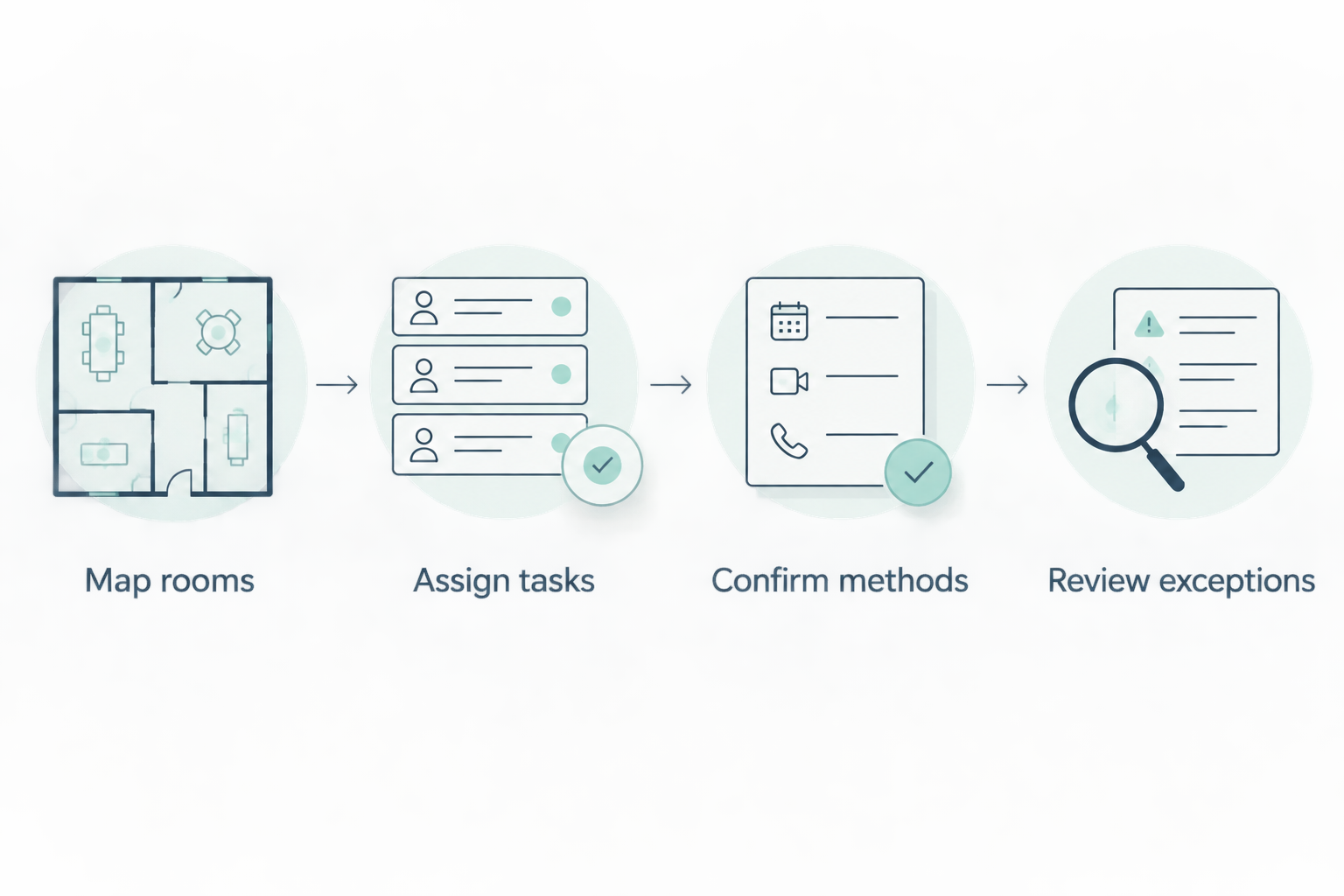
Assign responsibility and methods before treating a checklist as ready to use.
Before requesting service, identify occupied hours, access arrangements, restricted rooms, and who can authorize changes. Ask how the team receives site-specific instructions and how completion concerns are handled. Those questions make reliability concrete without relying on a general promise.
Plan floor care separately from routine cleaning
Your 2026 floor plan needs a distinction between ordinary cleaning and work involving an existing floor finish. Sweeping or mopping instructions do not establish whether a surface needs stripping, sealing, or another maintenance process.
Decisions about floor stripping and sealing frequency depend on the flooring system, the condition of its finish, and its maintenance instructions—not simply on the building being a school or daycare. Identify the material before specifying a treatment.
Discuss access and furniture movement separately from routine janitorial duties. If the proposed work changes how a room can be used, record that restriction in the handoff rather than leaving teachers or opening staff to discover it.
Keep home routines and facility routines connected—not identical
Families arranging house cleaning in Tacoma and administrators arranging commercial cleaning services in Tacoma both need clear scope and preparation. The difference is responsibility: a household plan covers the home, while a facility plan must also account for shared spaces, staff duties, and applicable operating requirements.
Keep 2 separate checklists when your family manages both home routines and daycare preparation. Use the home list for household surfaces and belongings; use the facility list for items and procedures the school or daycare controls. Avoid sending cleaning products or giving treatment instructions without agreement from the facility.
At home, identify surfaces needing attention, put away personal papers, and communicate material-care concerns before a visit. At work, identify restricted documents, occupied rooms, and access contacts. Clear preparation supports both residential and commercial cleaning without pretending the settings have identical needs.
What the ranking prioritizes
This ranking puts named surfaces and activity-linked tasks ahead of cosmetic finishing. It then adds floors, textiles, and written handoffs so the checklist covers both physical work and responsibility.
The order is a planning recommendation, not a measured comparison of cleaning outcomes. In 2026, your facility's actual rooms, operating procedures, and applicable requirements should determine the final task sequence. A daycare with nap areas needs a different working list from a school without them.
Which checklist should you choose?
Start with high-touch surfaces, then add the room-specific routines your facility requires. Do not choose between restroom, eating-area, and shared-object procedures as though they were optional alternatives; use the ranking to organize the work, not to omit necessary tasks.
When discussing service with Pureandcleancleaning, describe the building's use and ask which duties can be included. You can request a quote with your room list, preferred schedule, access arrangements, and proposed division of responsibilities. Confirm the scope before booking.
FAQ
What's the best cleaning checklist for a Tacoma school or daycare?
Start with high-touch surfaces, then add dedicated restroom, eating-area, shared-object, floor, and textile procedures. Assign responsibility and document unfinished work rather than relying on one checkbox per room.
Should school staff and outside cleaners use the same checklist?
Use a coordinated checklist with clearly separated responsibilities. Staff need instructions for operating-hour tasks, while the contracted scope should identify what happens during scheduled cleaning visits.
Is cleaning the same as sanitizing or disinfecting?
No. Cleaning, sanitizing, and disinfecting are different processes; follow applicable facility requirements and product labels to select and carry out the appropriate task.
How often should a daycare clean shared toys?
Follow applicable childcare requirements and the facility's written procedures for each type of object and use. Identify items needing removal from circulation, their required treatment, and who returns them to use.
What should I prepare before requesting commercial cleaning services in Tacoma?
Prepare a room list, operating hours, access instructions, restricted areas, and the duties you want included. Confirm any school-specific procedures, laundry arrangements, and periodic floor work separately.
Does Pureandcleancleaning offer both residential and commercial cleaning?
Yes. Pureandcleancleaning offers residential house cleaning and commercial janitorial services in Tacoma, Seattle, and Pierce County; confirm the proposed scope for your specific home or facility before booking.
One last thing
An unchecked task and an inaccessible room are different problems. Give your checklist separate ways to record them. That small distinction tells the next person whether to perform the work, arrange access, or contact the person responsible—without guessing what an empty box means.