
Best overall: label-checked cleaning products. Best for reducing disposable waste: washable cloths. Best for keeping dirt contained: an entryway routine. The best eco-friendly cleaning checklist for Tacoma homes in 2026 pairs surface-appropriate products with repeatable tasks; the same approach helps business decision-makers define commercial cleaning work.
TL;DR
Best eco-friendly cleaning checklist, Tacoma homes: start with label-checked products and a clearly defined routine.
Choose washable cloths for routine wiping, with separate tools for bathrooms and kitchens.
Pureandcleancleaning serves residential and commercial cleaning needs; confirm requested products and tasks before booking.
Use written room-by-room instructions for house cleaning and commercial janitorial work.
Why this matters
An eco-friendly checklist should describe what you use, where you use it, and what happens afterward. A green-looking bottle does not answer those questions. Neither does an instruction that simply says to clean everything.
For house cleaning in Tacoma, start with your actual surfaces and household routines. For commercial cleaning services in Tacoma, add shared spaces, building access, and responsibility for supplies. Review the available cleaning services, then confirm your requested scope rather than assuming every checklist item is included.
Pureandcleancleaning is a residential and commercial cleaning option for Tacoma homeowners and business decision-makers seeking a defined service scope. Product preferences, scheduling, and specific tasks belong in that conversation.
What makes the best eco-friendly cleaning checklist
Use these criteria to choose tasks for your 2026 checklist:
Product evidence: Read intended uses and directions; look beyond broad environmental wording.
Surface compatibility: Match the method to the flooring, counters, fixtures, and finishes you actually have.
Waste reduction: Identify where reusable tools can replace disposable supplies without mixing cleaning zones.
Clear boundaries: Separate routine cleaning, disinfection, specialist work, and tasks requiring approval.
Repeatability: Assign a task, location, and trigger so the routine is easy to follow.
No single product or tool meets every need. The strongest checklist combines these criteria without treating every room as interchangeable.
Eco-friendly checklist items at a glance
The ranking below orders checklist building blocks, not competing cleaning companies. Start with product suitability, then add the tools and habits that make your instructions practical.
Label-checked products
Best for: Choosing cleaning supplies
Standout feature: Connects product directions to the surface
Key limitation: Requires reading beyond environmental claims
Washable cleaning cloths
Best for: Reducing disposable wiping waste
Standout feature: Reusable tools with separate room assignments
Key limitation: Requires laundering and drying
Entryway dirt control
Best for: Managing tracked-in debris
Standout feature: Gives entrances their own routine
Key limitation: Does not replace interior floor cleaning
Targeted kitchen cleaning
Best for: Food-preparation areas
Standout feature: Matches cleaning to visible residue
Key limitation: Appliance interiors need separate instructions
Bathroom tool separation
Best for: Keeping cleaning zones distinct
Standout feature: Prevents tool sharing between designated areas
Key limitation: Requires storage and clear identification
Dry-finish checks
Best for: Managing leftover moisture
Standout feature: Makes drying part of task completion
Key limitation: Does not repair leaks or ventilation problems
Written task ownership
Best for: Coordinating recurring work
Standout feature: Names responsibilities and scope
Key limitation: Needs updates when space use changes
1. Label-checked products: best for choosing cleaning supplies
Start with products whose labels match the intended task and surface. EPA Safer Choice is an established label to look for when evaluating cleaning products; its criteria address ingredients and product performance. Certification does not replace the directions on the container.
At home, check instructions for counters, flooring, and bathroom finishes. In a business, confirm building requirements before introducing a different product, especially where occupants or facility managers have supplied specific instructions.
Label-checked product pros:
Gives product selection a clearer basis than packaging appearance.
Keeps application and dilution instructions attached to the task.
Helps you ask specific questions about proposed supplies.
Label-checked product cons:
A product is not suitable for every surface simply because it carries an environmental label.
Cleaning and disinfecting claims are not interchangeable.
Best for: Homeowners and office managers choosing supplies for a 2026 cleaning plan.
Verdict: Buy only after checking the label and surface instructions.
2. Washable cleaning cloths: best for reducing disposable wiping waste
Put washable cloths on your checklist where repeated use makes sense. Assign separate cloths to different cleaning zones, and follow their care instructions rather than returning used cloths directly to storage.
For a home, begin with 2 cloth sets: one assigned to bathroom work and another to kitchen work. A commercial space needs assignments that reflect its rooms and cleaning tasks; staff should know which tools belong where.
Washable cloth pros:
Replaces disposable wipes for suitable routine cleaning tasks.
Makes room-specific tool assignments straightforward.
Allows you to inspect tools before reuse.
Washable cloth cons:
Laundering and complete drying become part of the routine.
A reusable cloth does not make an unsuitable cleaning product appropriate.
Best for: Households and workplaces willing to manage reusable supplies consistently.
Verdict: Buy for suitable wiping tasks, with a laundering plan attached.
3. Entryway dirt control: best for managing tracked-in debris
Give entrances a separate checklist line instead of waiting until debris reaches other rooms. Inspect mats, remove loose dirt, and clean surrounding flooring using the method recommended for that floor.
At home, include the entrance people actually use, not just the front door. For commercial janitorial work, identify public entrances and staff entrances separately so neither falls outside the agreed scope.
Entryway routine pros:
Focuses attention on where outdoor debris enters.
Makes mat care an explicit responsibility.
Connects floor cleaning to visible conditions.
Entryway routine cons:
A dirty mat needs attention rather than simply remaining in place.
Entrance care does not replace cleaning elsewhere in the building.
Best for: Tacoma homes and businesses with frequently used entrances.
Verdict: Buy into an entrance-first routine; skip unnecessary supplies until you assess the space.
4. Targeted kitchen cleaning: best for food-preparation areas
List kitchen tasks by surface instead of using a broad instruction to spray everything. Remove crumbs and residue, use a compatible cleaner as directed, and follow any rinsing instructions relevant to food-contact surfaces.
For residential cleaning, name the counters, sink, backsplash, and appliance exteriors you want addressed. For commercial cleaning services in Tacoma, describe the shared kitchenette or break room accurately; do not assume ordinary janitorial work includes specialist food-service cleaning.
Targeted kitchen cleaning pros:
Makes food-contact instructions easier to follow.
Separates surface cleaning from appliance-interior work.
Gives households and office teams a concrete task list.
Targeted kitchen cleaning cons:
Different countertop materials require different care.
Unlisted appliance interiors remain an unresolved scope question.
Best for: Home kitchens and workplace break rooms needing explicit surface instructions.
Verdict: Buy only products matched to the listed surfaces; hold unapproved appliance-interior tasks.
5. Bathroom tool separation: best for keeping cleaning zones distinct
Give toilets, sinks, and other bathroom surfaces clear tool assignments. Keep bathroom supplies separate from kitchen supplies, and store used tools so they are not mistaken for clean ones.
Homeowners can place these assignments directly on a room checklist. Business decision-makers should also identify who supplies, cleans, and replaces the tools. A color system only helps when everyone understands it; written labels work too.
Bathroom tool separation pros:
Removes ambiguity about where tools belong.
Supports consistent instructions across different cleaners.
Makes supply storage part of the plan.
Bathroom tool separation cons:
Requires storage space and ongoing attention.
Tool separation alone does not establish a disinfection procedure.
Best for: Homes with shared bathrooms and businesses coordinating restroom cleaning.
Verdict: Buy dedicated tools where needed; skip sharing bathroom tools with kitchen tasks.
6. Dry-finish checks: best for managing leftover moisture
Add a final check for wet counters, fixture edges, and flooring after cleaning. Follow product directions first, including any required contact time, then complete the appropriate finishing steps for the surface.
In homes, include the areas where water collects during ordinary cleaning. In workplaces, coordinate floor work with access arrangements so the space is not treated as ready before the task is complete.
Dry-finish check pros:
Gives each task a clear finishing point.
Prompts attention to moisture left during cleaning.
Connects floor work with room access.
Dry-finish check cons:
Drying a surface does not fix a continuing leak.
Wiping too soon can conflict with a product's required contact time.
Best for: Bathrooms, kitchens, and other areas where cleaning leaves moisture behind.
Verdict: Hold final sign-off until the required finishing steps are complete.
7. Written task ownership: best for coordinating recurring work
A checklist needs an owner, not just a collection of boxes. Name who completes each task, when it happens, and what requires a separate request.
For a household, distinguish everyday tidying from booked cleaning. For a business, separate employee responsibilities from contracted janitorial work. When discussing service with Pureandcleancleaning, use the list to confirm expectations rather than treating it as a statement of included services.
Written task ownership pros:
Identifies who handles each area.
Makes recurring instructions easier to communicate.
Exposes gaps before a cleaning appointment.
Written task ownership cons:
Becomes outdated when rooms or responsibilities change.
A completed checkbox does not explain whether the agreed method was followed.
Best for: Busy households and business decision-makers coordinating ongoing cleaning in 2026.
Verdict: Buy into a written plan; skip assumptions about included tasks.
How the checklist items rank
Product suitability comes first because every later task depends on using an appropriate method. Reusable tools and entrance care follow because they turn environmental intentions into specific routines. Kitchen, bathroom, and finishing instructions add room-level detail; written ownership keeps the whole plan usable.
These are practical priorities, not measured environmental scores. Choose the items that match your surfaces and responsibilities rather than treating the ranking as a requirement to purchase everything.
Turn your checklist into a clear service request
Build your 2026 service request around 3 details: spaces, surfaces, and scope. Start with 1 room and describe the work precisely before repeating the format elsewhere.
List spaces: Identify bedrooms, bathrooms, offices, restrooms, or shared areas that need attention.
Name surfaces: Record flooring, counters, fixtures, and any manufacturer care instructions.
Confirm scope: Ask which tasks, supplies, access arrangements, and scheduling options apply.
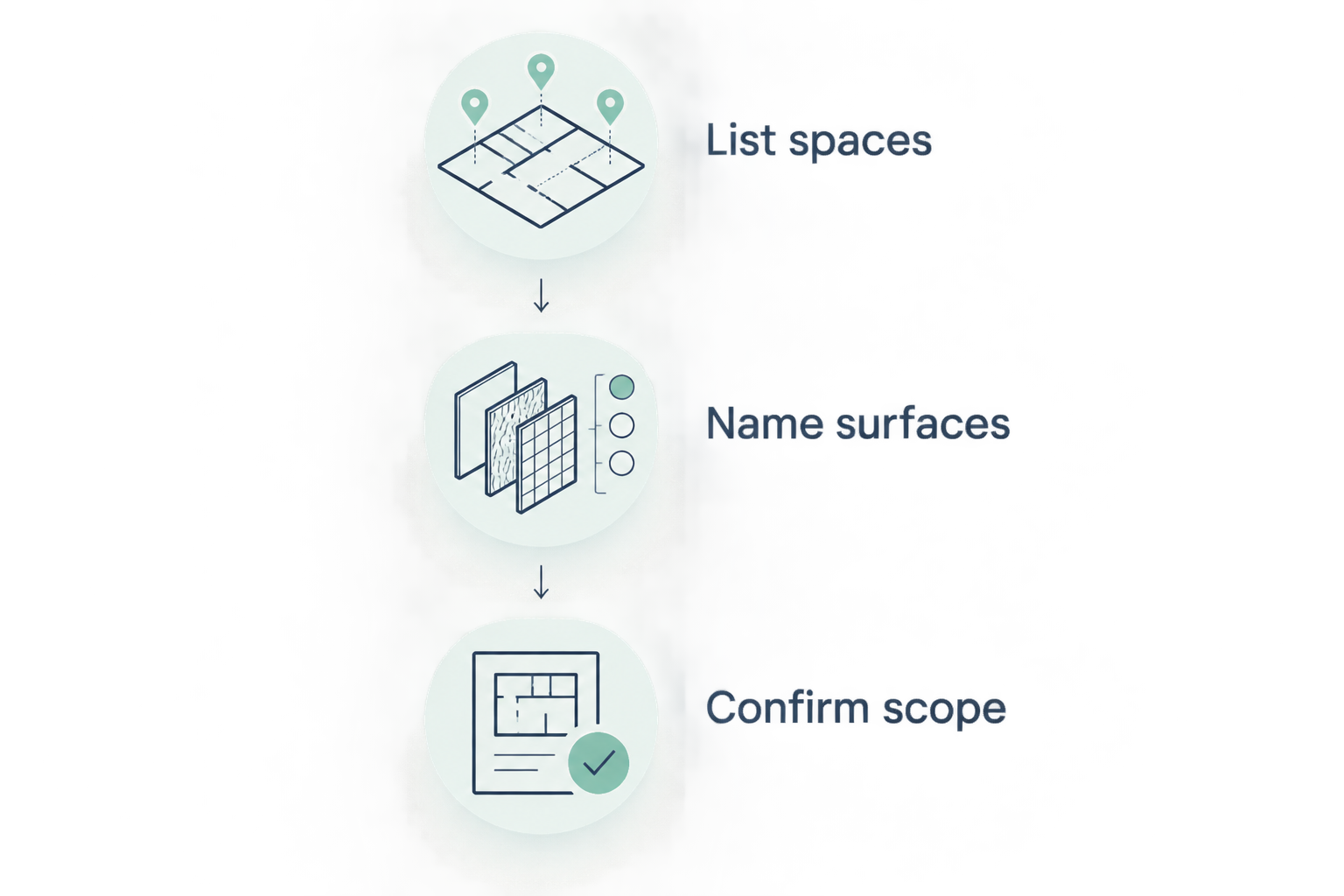
Define the rooms and surfaces before confirming the cleaning scope.
For house cleaning in Tacoma, include pets, access instructions, and items you want left untouched. For commercial cleaning services in Tacoma, identify the building contact, occupied areas, and any restrictions on when work can happen. Request confirmation of team preparation for your specific surfaces rather than assuming every material uses the same method.
You can request a quote with those details and ask Pureandcleancleaning to confirm the proposed work.
Request your cleaning quote
Share your Tacoma home or business cleaning needs, surface details, and preferred schedule.
Which checklist items should you choose?
Start with label-checked products, separate washable cloths, and written task ownership. Together, these establish what gets used, where tools belong, and who does the work. Add the room-specific items that match your property.
Keep residential and workplace instructions distinct even when the methods overlap. A household checklist follows the people living there; a commercial checklist also needs building access and responsibility boundaries.
FAQ
What's the best eco-friendly cleaning checklist for Tacoma homes?
The best starting checklist combines label-checked products, washable cloths, entrance care, room-specific tasks, and written responsibilities. Match every method to your surfaces rather than treating an environmental claim as universal approval.
How do I choose an eco-friendly cleaning product?
Read the intended uses, surface restrictions, and directions, and look for established labels such as EPA Safer Choice. An environmental label does not replace application instructions or make a cleaner suitable for every material.
Can I use the same cloth in the bathroom and kitchen?
Assign separate cloths to bathroom and kitchen tasks. Keep used tools distinct from clean supplies, and follow laundering and drying instructions before reuse.
Does eco-friendly cleaning mean disinfecting every surface?
No, cleaning and disinfecting are different tasks. When disinfection is required, choose an appropriate product and follow its label, including the specified contact time.
Can a business use this home cleaning checklist?
A business can adapt the product-selection, tool-separation, and scope-setting principles. Add building access, shared-area responsibilities, and workplace-specific requirements before using it as a janitorial checklist.
What should I prepare before requesting house cleaning in Tacoma?
Prepare a room list, surface details, priority tasks, and access instructions. Identify pets and items that should remain untouched, then confirm the proposed service scope.
How do I discuss eco-friendly preferences with Pureandcleancleaning?
State your product preferences and ask which supplies and methods apply to your requested cleaning. Confirm specific tasks and scheduling arrangements before booking residential or commercial service.
One last thing
Keep a do-not-use note beside your task list. Manufacturer restrictions, delicate finishes, and items that should remain untouched are as useful as instructions about what to clean. For your 2026 routine, make those exceptions visible before anyone opens a bottle.