
Best overall checklist item: a written responsibility map. Best for clinical boundaries: a treatment-room handoff. Best for consistent follow-through: a closing sign-off. This 2026 guide ranks cleaning checklist items for Tacoma dental offices by the specific job each one solves.
TL;DR
Best cleaning checklist Tacoma dental offices: start with task ownership, not a longer list of surfaces.
Keep dental instruments, treatment equipment, and clinical disinfection separate from general janitorial assignments.
Pureandcleancleaning offers Tacoma residential cleaning and commercial janitorial services; confirm the exact dental-office scope before booking.
Give restrooms, shared touchpoints, floors, and unresolved issues their own checklist entries.
Why this matters
A dental office needs more than a tidy waiting room. Your checklist must distinguish ordinary building cleaning from clinical tasks that require the practice’s procedures, equipment instructions, and appropriately trained personnel.
A general janitorial checklist does not replace a dental infection-control protocol. Use this 2026 guide to organize responsibilities, not to establish treatment-room disinfection or instrument-processing procedures.
Pureandcleancleaning provides residential cleaning and commercial janitorial services in Tacoma, Seattle, and Pierce County. Review the cleaning services, then describe your office’s requirements rather than assuming every dental task falls within a general cleaning visit.
What makes the best dental-office cleaning checklist?
Judge your 2026 checklist against these criteria before adding more tasks:
Clear ownership: Every task names the person or team responsible for completing it.
Defined boundaries: Clinical work and ordinary janitorial work appear as separate assignments.
Specific locations: Entries identify the surface or room instead of saying only “clean office.”
Usable instructions: Tasks refer to applicable product labels, equipment instructions, and office procedures.
Practical scheduling: Work fits patient hours, staff access, and the agreed service scope.
Documented exceptions: Staff can record unfinished work and notify the responsible person.
Organize the checklist around 3 zones: public areas, staff areas, and clinical areas. Then create 2 schedules: tasks performed during office operations and tasks assigned to the closing or cleaning visit. Give each task 1 named owner so responsibility does not disappear between teams.
These are organizational choices, not regulatory minimums. Your practice’s clinical requirements remain separate.
Dental-office checklist items at a glance
1. Written responsibility map
Best for: Defining accountability
Standout feature: Names the owner and boundary for each task
Key limitation: Needs updating when duties change
2. Treatment-room handoff
Best for: Separating clinical and janitorial work
Standout feature: Identifies what is released for general cleaning
Key limitation: Cannot replace clinical procedures
3. Restroom reset
Best for: Managing a shared-use room
Standout feature: Groups fixtures, supplies, floors, and exceptions
Key limitation: Needs attention between scheduled visits
4. Shared-touchpoint checklist
Best for: Preventing overlooked shared surfaces
Standout feature: Names specific handles, switches, and counters
Key limitation: Does not cover every surface or clinical item
5. Floor and entryway care
Best for: Planning cleaning around access
Standout feature: Separates entryways, open floors, and obstructions
Key limitation: Does not replace spill response
6. Closing sign-off
Best for: Recording completion and follow-up
Standout feature: Carries unfinished tasks to a named person
Key limitation: Depends on accurate entries
1. Written responsibility map: best for accountability
A responsibility map states who handles each cleaning task and who receives questions. Start with the office manager, clinical lead, and cleaning contact, then assign work by room and task rather than giving everyone a vague share of responsibility.
For example, distinguish reception-floor cleaning from treatment-chair cleaning. Proximity does not make those tasks interchangeable.
Responsibility map pros:
Gives staff and cleaners a common reference.
Makes excluded tasks visible before a visit.
Helps new team members understand their assignments.
Responsibility map cons:
Becomes unreliable when staffing or service scope changes without an update.
Does not explain the correct cleaning method by itself.
Best for: Office managers setting up or revising a cleaning arrangement.
Include the location, task, owner, timing, and escalation contact in each entry. Replace “team responsibility” with an actual role, and identify a backup when the primary person is absent.
Verdict: Buy into this first. A longer checklist cannot compensate for unclear ownership.
2. Treatment-room handoff: best for clinical boundaries
A treatment-room handoff tells the cleaning team which areas are ready for the agreed janitorial work and which remain under clinical control. Your practice should define that handoff through its own clinical procedures.
Do not assign instrument processing, dental waterline maintenance, sharps handling, or treatment-equipment disinfection through a generic office-cleaning checklist. Those tasks need their own procedures and responsible personnel.
Treatment-room handoff pros:
Separates ordinary cleaning from clinical responsibilities.
Gives cleaners a clear route for reporting unexpected items.
Lets the practice identify rooms that are not ready for entry.
Treatment-room handoff cons:
Requires coordination between clinical staff and the cleaning contact.
Fails when room status is unclear or instructions conflict.
Best for: Practices sharing treatment-area access with an outside cleaning team.
Specify what cleaners should do if they encounter an exposed sharp, an unidentified spill, or equipment left in the work area. The checklist should direct them to stop and notify the designated contact, not improvise.
Verdict: Buy into a formal handoff; skip assumptions about clinical work.
3. Restroom reset: best for shared-use rooms
A restroom checklist groups the work that belongs in one room: agreed fixture cleaning, accessible surfaces, floors, waste, and supply checks. Write each task separately so an emptied bin does not stand in for a completed restroom.
Clarify who supplies soap, paper products, liners, and cleaning materials. A supply check is useful only when someone owns replenishment.
Restroom reset pros:
Makes room-level expectations easy to review.
Connects cleaning tasks with supply shortages and maintenance reports.
Works as a separate checklist for staff checks between visits.
Restroom reset cons:
Cannot address every issue through an after-hours visit alone.
Does not substitute for plumbing repairs or other maintenance.
Best for: Offices coordinating patient and employee restroom use.
Keep restroom tools and methods distinct from those used in other areas under your written procedures. Follow applicable product labels, including surface compatibility and any required contact time; do not create a universal spray-and-wipe instruction.
Verdict: Buy into room-specific entries; skip a single “restroom done” box.
4. Shared-touchpoint checklist: best for overlooked surfaces
A shared-touchpoint list names the nonclinical surfaces that different people handle, such as entrance handles, reception counters, light switches, and breakroom handles. Review the actual office layout rather than copying an unrelated building’s list.
Separate ordinary furniture from electronics and dental equipment. Screen cleaning and equipment cleaning need the relevant manufacturer’s instructions and a clearly assigned owner.
Shared-touchpoint checklist pros:
Turns an imprecise instruction into identifiable tasks.
Helps separate public areas from staff-only spaces.
Makes changes in room use easier to reflect in the checklist.
Shared-touchpoint checklist cons:
Can miss surfaces if the list is never reviewed.
Does not authorize cleaners to move documents or operate equipment.
Best for: Reception areas, staff rooms, and other shared nonclinical spaces.
Ask staff to secure paperwork and personal items before the visit. State what happens when a listed surface is covered: leave it undisturbed, record the obstruction, and notify the agreed contact.
Verdict: Buy into a named surface list; skip “wipe everything.”
5. Floor and entryway care: best for access planning
Floor care needs a route, an agreed method for each floor material, and a plan for rooms that remain occupied. Identify entry mats, accessible floor areas, furniture boundaries, and spaces excluded from the visit.
For your 2026 schedule, distinguish routine floor cleaning from immediate spill response. Staff need a separate process for conditions that arise while the office is open.
Floor and entryway care pros:
Helps schedule work around room access.
Identifies obstacles before cleaners arrive.
Keeps floor-material instructions attached to the task.
Floor and entryway care cons:
Does not cover restoration or specialty treatments unless expressly agreed.
Cannot resolve inaccessible areas without staff preparation.
Best for: Practices coordinating cleaning with occupied rooms and closing duties.
Specify whether chairs, bins, and other movable items are included in preparation or cleaning duties. Do not assume cleaners will move dental equipment, disconnect cables, or enter restricted storage areas.
Verdict: Buy into a defined route; skip open-ended equipment-moving instructions.
6. Closing sign-off: best for dependable follow-through
A closing sign-off records completed tasks, exceptions, and the person who needs to respond. Keep completion and problem reporting separate so an unchecked box has an explanation.
Useful exceptions include an inaccessible room, an obstructed counter, a supply shortage, or an issue referred to the clinical lead. Record the location and next action without adding patient information.
Closing sign-off pros:
Gives the next shift a clear handoff.
Keeps incomplete work visible.
Creates a place to record recurring access problems.
Closing sign-off cons:
Does not prove that every task followed the correct method.
Adds little value if nobody reviews unresolved entries.
Best for: Offices dividing responsibilities between daytime staff and an evening cleaning team.
Choose one place for the record, whether paper or digital. Identify who reviews it and how urgent issues reach that person outside the normal review process.
Verdict: Buy into documented exceptions; skip a signature without task details.
How these checklist items are ranked
The 2026 order puts ownership and clinical boundaries before individual cleaning tasks. Restrooms, touchpoints, and floors follow because each needs distinct instructions; closing documentation then connects completion with follow-up.
This ranking evaluates checklist usefulness, not cleaning-company performance or clinical compliance. A completed checklist is a record of assigned work, not proof of an infection-control outcome.
Turn the checklist into an agreed service scope
Use a short sequence before the first visit:
Map areas: Identify public, staff, and clinical spaces, including restricted rooms.
Assign tasks: Separate practice responsibilities from the work requested from cleaners.
Confirm access: Explain arrival arrangements, occupied rooms, preparation, and closing responsibilities.
Review exceptions: Agree on how unfinished tasks and unexpected conditions will be reported.
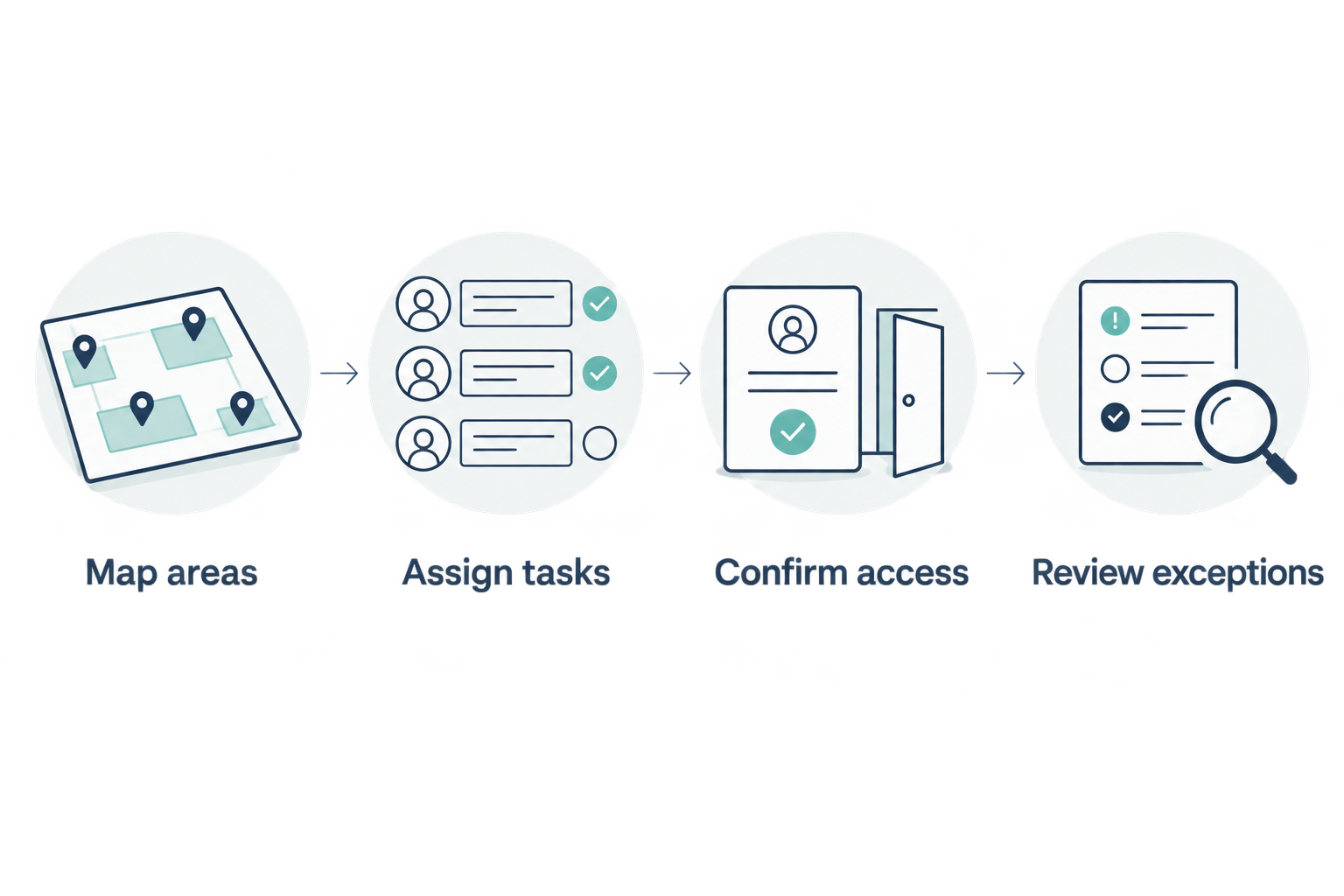
Agree on responsibilities and access before the cleaning visit.
When requesting commercial cleaning services in Tacoma, describe your premises as a dental office and distinguish the general janitorial work you want from clinical duties. Ask who will perform the agreed work, what task-specific training applies, and how questions reach your office contact.
For house cleaning in Tacoma, the same preparation principle applies: name the rooms, priorities, delicate surfaces, access arrangements, and items that should remain untouched. A household scope and a dental-office scope still need separate instructions; neither should be copied unchanged into the other.
Pureandcleancleaning is best suited to Tacoma readers seeking residential cleaning or commercial janitorial services with a clearly defined scope. To discuss your location and requested tasks, request a quote. Confirm the dental-office scope before arranging service.
Which checklist items should you choose?
Start with the responsibility map, then add the other items as separate sections. Treat the list as a connected workflow rather than choosing between restroom care and floor care.
For a 2026 revision, walk through the office with the person responsible for clinical procedures and the person coordinating janitorial work. Resolve overlapping duties before the checklist reaches the people expected to use it.
FAQ
What’s the best cleaning checklist for a Tacoma dental office?
The best starting point is a checklist that assigns each task to a responsible person and separates clinical duties from general janitorial work. Add room-specific tasks, scheduling instructions, and a place to record exceptions.
Can a general cleaning team handle dental instruments?
Do not include dental instrument processing in a general janitorial assignment. Keep instrument handling and reprocessing under the practice’s designated clinical procedures and responsible personnel.
What should dental office staff do before cleaners arrive?
Staff should secure patient information, identify restricted areas, and complete the agreed clinical handoff. They should also explain which surfaces must remain untouched and which rooms are ready for general cleaning.
Should a dental office use daily and closing checklists?
Separate operating-hours tasks from closing or scheduled cleaning tasks. Assign timing according to the practice’s procedures, room use, and agreed service scope rather than applying one schedule to every task.
Can eco-friendly products replace a dental office’s required disinfectants?
An eco-friendly description does not establish that a product meets a dental office’s disinfection requirements. Follow the practice’s clinical procedures, applicable product labels, and equipment instructions.
Does Pureandcleancleaning offer residential and commercial cleaning in Tacoma?
Pureandcleancleaning offers residential cleaning and commercial janitorial services in Tacoma, Seattle, and Pierce County. Describe your dental office and requested work so the specific service scope can be confirmed.
Can I use a house-cleaning checklist for a dental office?
A house-cleaning checklist is not a substitute for a dental-office checklist. Some ordinary room-cleaning tasks overlap, but clinical boundaries, patient information, equipment instructions, and practice procedures require separate treatment.
One last thing
Add an unable to complete option beside the completion box. A blocked room and a finished room should never produce the same record; naming the obstacle gives the next person something specific to resolve.