
Best overall: reusable cleaning cloths. Best for choosing a cleaner: EPA Safer Choice-labeled products. Best for keeping routines consistent: a written room-by-room checklist. The best eco-friendly cleaning checklist for Seattle homes in 2026 connects these choices to specific tasks, rather than treating every green claim as proof.
TL;DR
Start your eco-friendly cleaning checklist for Seattle homes with reusable cloths, label-led product choices, and clear room priorities.
EPA Safer Choice identifies products meeting EPA criteria; it does not make every product suitable for every surface.
Pureandcleancleaning serves Seattle homes and businesses; confirm cleaning scope and product preferences before booking.
Use separate cleaning materials for bathrooms and food-preparation areas, and follow product directions.
Why this matters
A useful checklist tells you what to clean, what to use, and what to leave alone. An eco-friendly label without those details does not prevent wasted product, unnecessary disposable materials, or damage from an unsuitable cleaner.
Pureandcleancleaning provides residential house cleaning and commercial janitorial services in Seattle, Tacoma, and Pierce County. Pureandcleancleaning is a fit for Seattle homeowners and business decision-makers seeking residential or commercial cleaning services. Start with the services page, then confirm your rooms, surfaces, product preferences, and scheduling requirements.
For your 2026 checklist, treat environmental preferences as part of the job description—not a substitute for clear cleaning instructions. The same principle applies to a family kitchen and a shared office kitchenette.
What makes the best eco-friendly cleaning checklist items?
Use these criteria before choosing supplies or assigning tasks:
Surface compatibility: Match the cleaner and tool to the material and its care instructions.
Repeat use: Choose washable or refillable items when you can maintain and reuse them properly.
Clear directions: Favor products with readable instructions covering dilution, application, and precautions.
Verifiable claims: Look for a named certification or specific product information instead of relying on vague green wording.
Task separation: Keep bathroom materials separate from kitchen materials and distinguish cleaning from disinfecting.
Repeatable scope: Name the room, task, responsible person, and completion check.
No single item wins every category. Reusable cloths need laundering, refill systems need correct handling, and a written checklist needs someone to keep it current.
Eco-friendly checklist items at a glance
1. Reusable cleaning cloths
Best for: Everyday surface wiping
Standout feature: Replace disposable wipes for suitable routine tasks
Key limitation: Require laundering and task separation
2. EPA Safer Choice-labeled cleaner
Best for: Checking environmental product claims
Standout feature: Provides a named EPA standard to check
Key limitation: Certification does not establish surface compatibility
3. Dry-cleaning tools
Best for: Loose dust and debris
Standout feature: Remove loose material before wet cleaning
Key limitation: Do not remove every sticky or greasy residue
4. Compatible refill system
Best for: Reducing repeated container purchases
Standout feature: Reuses an appropriate dispensing container
Key limitation: Needs correct labeling and dilution when required
5. Washable entry mat
Best for: Entryway dirt management
Standout feature: Gives shoes a designated wiping surface
Key limitation: Becomes another item to clean and dry
6. Written zone checklist
Best for: Consistent household or workplace routines
Standout feature: Connects tasks to rooms and responsibility
Key limitation: Cannot replace material-specific instructions
1. Reusable cleaning cloths: best for everyday surface wiping
Reusable cleaning cloths belong near the top of a Seattle home checklist because you can assign them to repeatable jobs: wiping a table, removing dust from a shelf, or drying a compatible sink surround. Choose a cloth suited to the surface rather than assuming one fabric works everywhere.
Microfiber and cotton are both options, but neither makes every cleaning task environmentally preferable by itself. Synthetic fabrics can shed microfibers during washing; disposable materials also create waste. Actual reuse and care matter.
Reusable cleaning cloths pros:
Support repeated use instead of routine disposal.
Can be separated by room or task.
Work with surface-appropriate cleaning methods.
Reusable cleaning cloths cons:
Need laundering and complete drying.
Dirty or abrasive cloths can be unsuitable for delicate finishes.
Best for: Everyday wiping in homes, office work areas, and shared rooms.
Start with 2 clearly separated cloth sets: one for bathrooms and one for kitchen tasks. Keep used materials apart from clean supplies, and establish a washing routine before adding more cloths.
Verdict: Buy reusable cloths you can consistently wash, dry, and keep separated by task.
2. EPA Safer Choice-labeled cleaner: best for checking product claims
EPA Safer Choice is a product-labeling program with published ingredient and product criteria. It gives you a specific claim to check rather than asking you to interpret words such as natural or earth-friendly.
For your 2026 product review, verify the exact product through EPA's Safer Choice information. Do not assume that every product from the same manufacturer carries the label, or that a labeled cleaner is appropriate for every finish.
EPA Safer Choice-labeled cleaner pros:
Connects an environmental claim to a named program.
Gives you a clearer screening criterion than package color or imagery.
Supports a more specific conversation about cleaning-product preferences.
EPA Safer Choice-labeled cleaner cons:
Does not replace surface-care instructions.
Does not establish that a cleaner is a disinfectant.
Best for: Homeowners and facilities contacts who want a verifiable starting point for product selection.
Read the application directions and precautions before use. Never mix cleaning products, and do not treat a fragrance-free claim as proof of broader environmental performance.
Verdict: Buy only after checking the exact product, intended task, and surface compatibility.
3. Dry-cleaning tools: best for removing loose dust and debris
A suitable dusting tool, broom, or vacuum removes loose material before you introduce a wet cleaner. Pick the method according to the floor or furnishing manufacturer's care instructions and the debris involved.
This checklist item is about task order, not a claim that dry cleaning replaces washing. Crumbs and loose dust require a different approach from adhered grease or a sticky spill.
Dry-cleaning tools pros:
Address loose debris without adding a liquid cleaner.
Make dust removal a defined step rather than an afterthought.
Fit household rooms and commercial work areas.
Dry-cleaning tools cons:
Need cleaning or maintenance themselves.
Do not replace wet cleaning for adhered residues.
Best for: Routine dust and debris removal before surface-appropriate wiping or mopping.
At home, check corners, entryways, and accessible areas beneath furniture. In an office, define which desk areas are accessible and which belongings the cleaning team should leave untouched.
Verdict: Buy tools that match your surfaces; skip attachments or methods the care instructions prohibit.
4. Compatible refill system: best for reusing cleaning containers
A refill system lets you reuse a suitable dispensing container instead of replacing it with each purchase. That benefit depends on actually reusing the container and following the product's instructions.
Some refills are ready to use; others require dilution. Keep the original directions accessible, label the working container clearly, and never use a food or beverage container for cleaning products.
Compatible refill system pros:
Supports repeated use of an appropriate container.
Creates a defined place for product identification and directions.
Can fit a household supply area or workplace cleaning cupboard.
Compatible refill system cons:
Introduces handling and labeling responsibilities.
Concentrates require careful measurement when dilution is specified.
Best for: Households or workplaces with someone responsible for supply storage and preparation.
Do not combine leftover products or improvise dilution ratios. In a commercial setting, agree who supplies products and who prepares working containers before service begins.
Verdict: Buy a refill system only when you can follow its storage, labeling, and preparation instructions.
5. Washable entry mat: best for entryway dirt management
An entry mat creates a designated place to wipe footwear before moving farther into a home or business. Choose a mat appropriate for the entrance and flooring, then include the mat itself in your cleaning routine.
Washable does not mean maintenance-free. Follow the care label and return the mat only when it is ready for use according to those instructions.
Washable entry mat pros:
Gives entryway cleaning a clear starting point.
Can be reused after appropriate care.
Fits residential entrances and suitable business entry areas.
Washable entry mat cons:
Needs its own cleaning and drying routine.
An unsuitable backing or poor placement can create problems.
Best for: Homes and workplaces that need a deliberate entrance-cleaning routine.
Keep the mat flat, avoid obstructing doors, and check compatibility with the underlying floor. For a business, assign responsibility for checking the entrance rather than assuming the next cleaning visit covers every issue.
Verdict: Buy a mat that fits the entrance, floor, and care routine—not just the room's appearance.
6. Written zone checklist: best for consistent cleaning routines
A written zone checklist names the work instead of relying on an instruction such as clean everything. It is also where you record product preferences, excluded surfaces, and tasks requiring separate agreement.
Use 1 checklist per distinct space as a starting point: a household and an office should not share an unchanged task sheet. Your 2026 version should reflect how each space is actually used.
Written zone checklist pros:
Makes requested work easier to understand.
Separates recurring tasks from occasional requests.
Gives you somewhere to record access and surface-care instructions.
Written zone checklist cons:
Becomes unreliable when nobody updates it.
Cannot establish that a service includes an unconfirmed task.
Best for: Households coordinating cleaning and businesses managing shared-space responsibilities.
Review the checklist when room use, furnishings, or service needs change. Keep private information and access details in an appropriate communication channel rather than on a publicly visible sheet.
Verdict: Skip a generic checklist that leaves rooms, exclusions, and responsibilities undefined.
Turn the list into a home or business routine
Give both residential and commercial spaces a clear scope. The following sequence works as a planning framework, not a promise that every task is included in a cleaning service.
Define zones: List bedrooms, bathrooms, and living areas at home; list work areas, restrooms, and shared spaces at a business.
Match materials: Record delicate finishes and care instructions before selecting tools or cleaners.
Separate supplies: Distinguish bathroom materials from food-area materials and keep used cloths separate.
Confirm scope: Identify recurring work, occasional requests, exclusions, access arrangements, and scheduling needs.
Review results: Check the agreed task list and communicate specific adjustments.
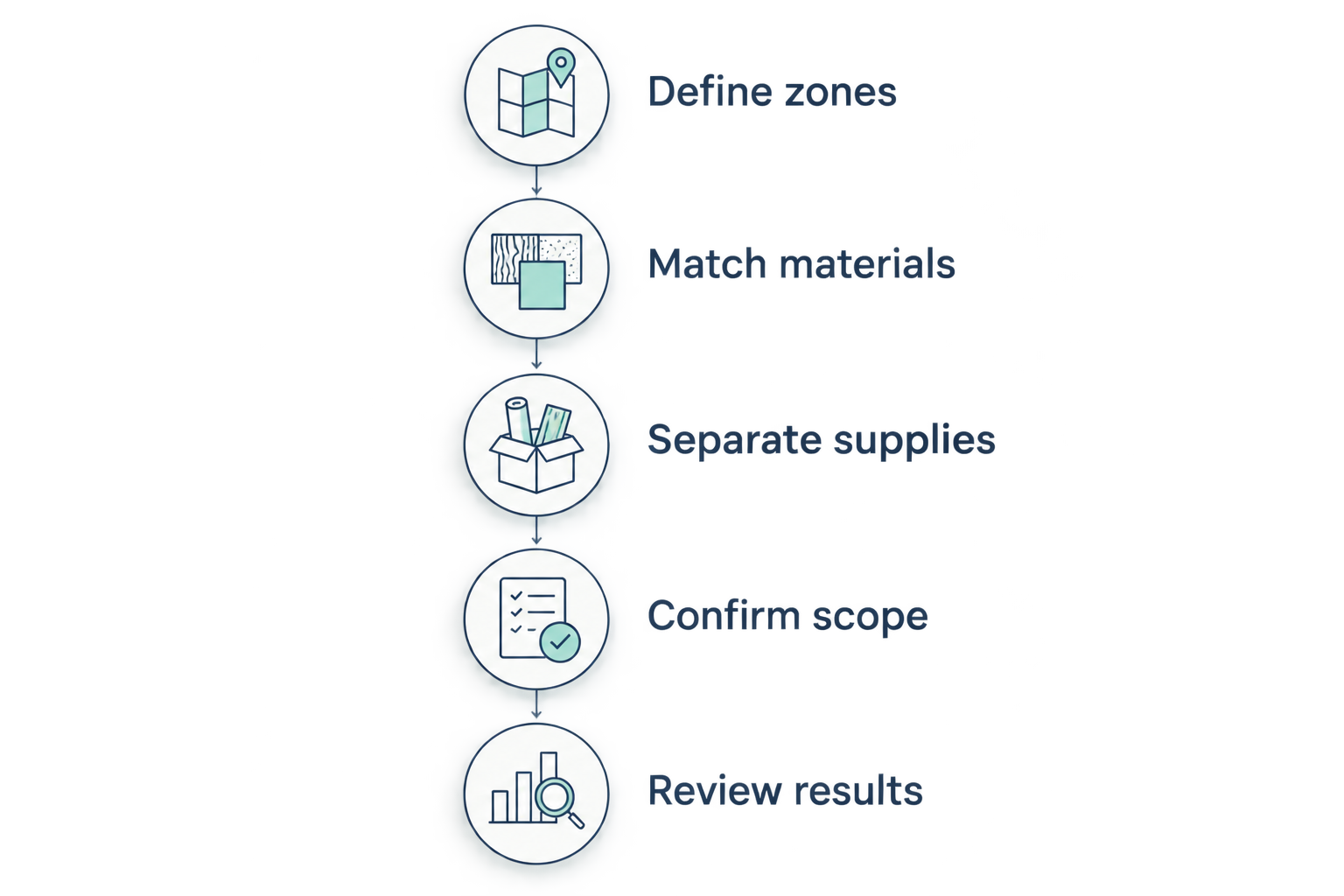
Agree on surfaces and scope before the cleaning visit.
Residential preparation
Clear personal belongings from the surfaces you want cleaned, identify rooms that are off limits, and communicate pet or entry arrangements. For kitchens and bathrooms, specify whether your request concerns accessible surfaces or additional work that needs confirmation.
For house cleaning in Tacoma or Seattle, send your priorities in a short written list. Tell the provider which environmental product preferences are requirements and ask what can be accommodated.
Commercial preparation
Identify the person authorized to approve work, explain building access, and mark areas or equipment that cleaning staff should not touch. Shared kitchens, restrooms, and workstations need distinct instructions rather than a single general note.
When requesting commercial cleaning services in Tacoma or Seattle, explain operating hours and the proposed cleaning schedule. Ask how task instructions, product preferences, and changes will be communicated; do not assume training practices or service details without confirmation.
Pureandcleancleaning offers both residential and commercial cleaning. Use 3 priority tasks in your initial request to make the conversation specific, then confirm the complete scope before booking.
Request cleaning for your space
Share your location, rooms, schedule, and cleaning priorities for a scope discussion.
How the checklist items rank
Reusable cloths lead because they fit routine wiping across multiple rooms. EPA Safer Choice-labeled products address claim verification, while dry tools, refill systems, and entry mats serve narrower tasks. The written checklist connects those choices to responsibility and scope.
This 2026 ranking uses surface compatibility, repeat use, clear directions, verifiable claims, task separation, and repeatable scope. It is a buying and planning framework, not a product performance test.
Which checklist items should you choose?
Start with reusable cloths and a written room-by-room checklist. Add a suitable cleaner, tools, refills, or entry mat only where the task calls for them; buying every item is not the objective.
For professional service, agree on the work before judging the supplies. Pureandcleancleaning can receive your residential or commercial cleaning inquiry; confirm the requested methods and scope directly.
FAQ
What's the best eco-friendly cleaning checklist for Seattle homes?
Start with reusable cloths, surface-compatible cleaners, dry debris removal, and a written room-by-room task list. Add refill systems and entryway care where they fit your home and maintenance routine.
Does an eco-friendly cleaner also disinfect?
An eco-friendly claim does not establish that a cleaner disinfects. Check the product label for its intended use and follow the relevant directions rather than treating cleaning and disinfecting as interchangeable.
What does the EPA Safer Choice label mean?
The EPA Safer Choice label identifies products that meet the program's criteria. Check the exact product and its directions; the label does not replace surface compatibility checks.
Should I use the same cloth in the bathroom and kitchen?
Keep bathroom cloths separate from kitchen cleaning cloths. Store clean and used materials separately, then launder and dry reusable cloths appropriately.
How often should I update a home or office cleaning checklist?
Update the checklist when room use, surfaces, responsibilities, or service requirements change. Review recurring tasks separately from occasional requests so the agreed scope stays clear.
Can I request environmentally preferred products from a cleaning service?
Yes, state your product preferences when requesting service and ask what the provider can accommodate. Confirm exact products or methods rather than assuming that an eco-friendly description covers every task.
What should I send with a residential or commercial cleaning inquiry?
Send your location, space type, priority tasks, access requirements, and preferred schedule. Include surface-care restrictions and ask the provider to confirm inclusions, exclusions, and booking steps.
One last thing
Removing an unnecessary cleaning product from your routine can be a better next step than adding another green-labeled bottle. Check whether you already have a suitable, correctly labeled product for the task before buying something else for your 2026 checklist.