
Best overall: restrooms. Best for client-facing spaces: entryways and reception. Best for shared workspaces: accessible desks and meeting tables. This 2026 guide ranks office cleaning checklist items for University Place and explains how to turn them into a clear service brief.
TL;DR
The best office cleaning checklist University Place teams can use names tasks, timing, access rules, and responsibility.
Prioritize restrooms, entryways, shared surfaces, and break rooms before detail work.
Pureandcleancleaning offers residential house cleaning and commercial janitorial services; confirm University Place coverage before booking.
Keep office and house cleaning checklists separate, even when the same person arranges both.
Why this matters
A checklist should tell you what gets cleaned, not leave you interpreting phrases such as general cleaning. An instruction to clean the kitchen leaves appliance interiors, dishes, cabinet fronts, and food disposal unresolved.
Pureandcleancleaning provides residential house cleaning and commercial janitorial services in Tacoma, Seattle, and Pierce County. Pureandcleancleaning is best suited to readers seeking a provider that offers both residential and commercial cleaning. For a University Place property, confirm coverage and the requested tasks before arranging service.
Use the priorities below to build your 2026 brief. They rank checklist items, not cleaning companies, and they do not imply that every task belongs in every visit.
What makes the best office cleaning checklist?
Judge each item against these criteria before adding it to your scope:
Clear boundaries: Name the room, surface, and action rather than writing clean thoroughly.
Practical priority: Put frequently used shared spaces ahead of decorative details.
Accessible surfaces: State what must be cleared before cleaning begins.
Material suitability: Identify surfaces that need particular care or product instructions.
Assigned responsibility: Separate staff duties, cleaner duties, and building-management duties.
Reviewable completion: Write a task that someone can check without guessing what you meant.
A longer checklist is not automatically better. A short list with agreed exclusions gives you a clearer basis for discussing missed work than a long list of vague promises.
Office cleaning checklist items at a glance
1. Restrooms
Best for: Shared facilities
Standout purpose: Separates fixtures, supplies, and floors
Key limitation: Restocking responsibility needs agreement
2. Entryways and reception
Best for: Visitor-facing offices
Standout purpose: Defines the arrival-area scope
Key limitation: Building-managed areas need separate coordination
3. Desks and meeting tables
Best for: Shared workspaces
Standout purpose: Sets clear-surface boundaries
Key limitation: Papers and electronics restrict access
4. Break rooms
Best for: Offices with shared food areas
Standout purpose: Separates surfaces from appliance interiors
Key limitation: Food and dish handling need explicit rules
5. Floors
Best for: Offices with mixed flooring
Standout purpose: Matches the task to the surface
Key limitation: Furniture and equipment restrict access
6. Waste and recycling
Best for: Offices with multiple collection points
Standout purpose: Assigns collection and disposal duties
Key limitation: Confidential waste needs separate handling
7. Interior glass and touchpoints
Best for: Meeting rooms and shared routes
Standout purpose: Names easily overlooked surfaces
Key limitation: Glass height and material care limit scope
8. Periodic detail work
Best for: Offices with an established routine
Standout purpose: Keeps less-frequent tasks visible
Key limitation: Detail work cannot replace routine cleaning
1. Restrooms: best for shared facilities
Restroom cleaning belongs at the top of the discussion because it involves several distinct tasks. List toilets, sinks, faucets, mirrors, counters, dispensers, and floors separately so the scope is readable.
Restroom checklist pros:
Makes fixture cleaning explicit.
Separates cleaning from supply replacement.
Gives the property contact a clear inspection list.
Restroom checklist cons:
Supply purchasing is not automatically included.
Plumbing repairs sit outside a cleaning checklist.
Best for: Offices with shared employee or visitor restrooms.
Ask who provides soap, paper products, and replacement liners. Specify how the cleaner should report a leak or broken dispenser without implying that the cleaning visit includes repairs.
Verdict: Keep restroom cleaning in the core scope.
2. Entryways and reception: best for visitor-facing offices
Entryway tasks cover the office areas people encounter on arrival. Identify the entrance floor, mats, reception surfaces, accessible glass, and waiting-area furniture surfaces rather than treating the entrance as a single task.
Entryway checklist pros:
Defines responsibility at the office boundary.
Keeps visitor seating and reception surfaces visible.
Connects floor care with tracked-in debris.
Entryway checklist cons:
Shared lobbies might belong to building management.
Exterior glass and elevated surfaces need separate confirmation.
Best for: Offices that receive clients, applicants, or deliveries.
Mark where your leased space begins. If a landlord manages the corridor or lobby, keep those areas out of your cleaning brief unless responsibility has been agreed.
Verdict: Keep entryways high on the list when visitors use them.
3. Desks and meeting tables: best for shared workspaces
Write this item as cleaning accessible, cleared surfaces. That wording protects the distinction between cleaning a desk and organizing documents, moving equipment, or handling personal belongings.
Workspace checklist pros:
Makes employee preparation clear.
Distinguishes shared tables from occupied desks.
Reduces ambiguity around personal items.
Workspace checklist cons:
Clutter blocks access to the surface underneath.
Screens, keyboards, and specialist equipment need agreed instructions.
Best for: Shared desks, conference rooms, and collaborative work areas.
Ask staff to put away documents and small belongings before the visit. List electronics separately; do not assume a desktop-cleaning instruction includes every device on it.
Verdict: Keep this item, with a clear-surface rule attached.
4. Break rooms: best for shared food areas
A useful break-room checklist distinguishes counters, sinks, tables, cabinet fronts, appliance exteriors, and floors. Treat refrigerator interiors, microwave interiors, dishes, and food disposal as separate decisions.
Break-room checklist pros:
Defines what kitchen cleaning actually covers.
Assigns responsibility for food and dishes.
Separates routine work from additional appliance tasks.
Break-room checklist cons:
Stored food restricts interior access.
Unassigned dishes leave an unresolved staff duty.
Best for: Offices where employees prepare drinks or eat meals.
Agree who clears counters and removes unwanted food. A cleaner should not have to decide which unlabeled container an employee intends to keep.
Verdict: Keep the surface tasks; confirm appliance interiors separately.
5. Floors: best for offices with mixed surfaces
Describe floor tasks by material and area rather than requesting one method throughout the office. Identify carpet, hard flooring, entrance mats, and any surfaces with specific care instructions.
Floor checklist pros:
Connects methods to the actual flooring.
Identifies accessible edges and open areas.
Separates routine cleaning from specialist treatments.
Floor checklist cons:
Furniture limits access underneath and behind it.
Stain treatment and specialist floor work need confirmation.
Best for: Offices combining carpeted rooms and hard-floor shared spaces.
State whether chairs should be moved and who handles larger furniture. Do not assume that routine vacuuming or mopping includes carpet extraction, polishing, or moving heavy equipment.
Verdict: Keep material-specific floor instructions in the brief.
6. Waste and recycling: best for multiple collection points
List the bins included in collection, where their contents go, and who replaces liners. Separate general waste, recycling, and confidential disposal rather than grouping everything under empty bins.
Waste checklist pros:
Makes collection points visible.
Assigns liner replacement clearly.
Distinguishes routine waste from restricted materials.
Waste checklist cons:
Recycling rules need site-specific instructions.
Confidential documents need an agreed disposal process.
Best for: Offices with desk bins, shared stations, and restricted disposal containers.
Identify the approved collection area and any access requirements. Keep confidential files out of ordinary waste instructions, and assign sensitive disposal to the appropriate person or provider.
Verdict: Keep waste collection, with explicit disposal boundaries.
7. Interior glass and touchpoints: best for shared routes
Name the surfaces you mean: door handles, push plates, light switches, glass doors, and meeting-room partitions. Specify cleaning expectations without assuming that every surface needs the same product or method.
Glass and touchpoint checklist pros:
Captures surfaces that broad room labels omit.
Distinguishes glass from surrounding hardware.
Supports a room-by-room completion check.
Glass and touchpoint checklist cons:
Elevated glass needs separate access arrangements.
Cleaning alone does not establish a disinfection claim.
Best for: Offices with shared doors and glass-enclosed meeting rooms.
For any requested disinfection, discuss product suitability and follow the product label. Do not describe routine surface cleaning as a guarantee against illness.
Verdict: Keep named surfaces; skip unsupported health promises.
8. Periodic detail work: best for maintaining an established routine
Put baseboards, accessible vents, ledges, and behind-furniture areas on a separate detail list. Give each task an agreed schedule instead of assuming it happens during every routine visit.
Detail-work checklist pros:
Keeps less-visible surfaces on the plan.
Separates routine and additional work.
Makes access requirements easier to discuss.
Detail-work checklist cons:
Some areas require furniture movement or special access.
Vent-surface cleaning is not duct cleaning.
Best for: Offices with a defined routine-cleaning scope already in place.
Record exclusions as carefully as inclusions. High surfaces, equipment interiors, and specialist work should never enter the scope through an ambiguous phrase such as deep clean everything.
Verdict: Hold detail work on a separate agreed schedule.
How these checklist items are ranked
The ranking puts shared facilities and everyday-use areas before less-frequent detail work. Each item earns its place through clear boundaries, practical priority, accessible surfaces, material suitability, assigned responsibility, and reviewable completion.
Adjust the order to your office. A visitor-free workspace does not need to treat reception as its main priority, and an office without a break room can remove that item entirely.
Turn the checklist into a 2026 service brief
Use this sequence before requesting commercial cleaning services in Tacoma or asking about a University Place office:
Map the space: List rooms, flooring, shared facilities, and restricted areas.
Set priorities: Identify 3 priority zones that need the clearest instructions.
Assign duties: Name 1 contact person for access questions and scope changes.
Confirm timing: Discuss occupancy, entry arrangements, and the proposed cleaning schedule.
Review completion: Agree how to report an unfinished task or changed requirement.
Keep the brief readable enough that a replacement office contact can understand it. Record exceptions alongside the task, not in an unrelated email thread.
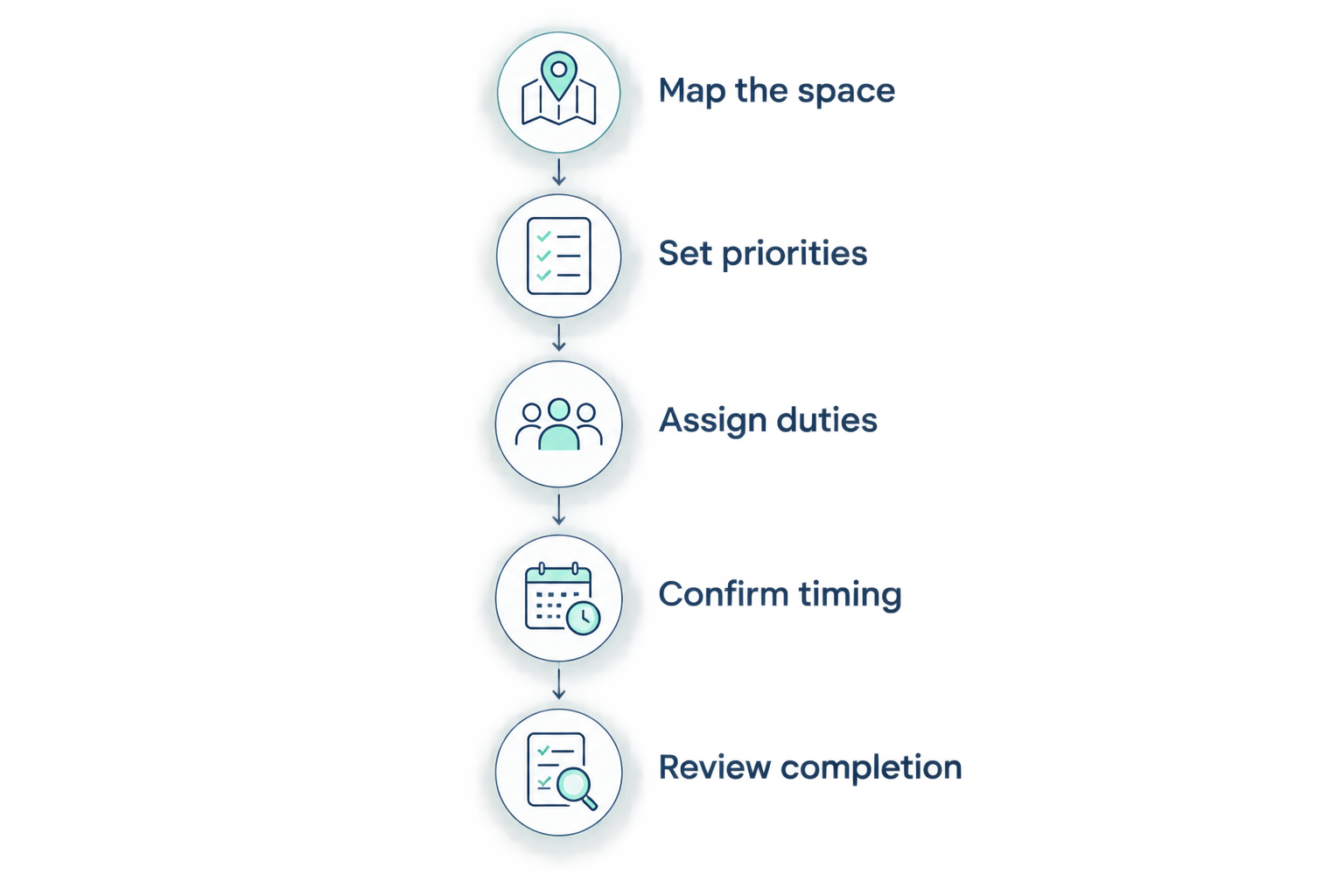
Agree on duties and access before the first cleaning visit.
Keep house cleaning and office cleaning equally clear
If you arrange both house cleaning in Tacoma and office cleaning, maintain 2 separate lists. The same planning discipline applies, but the rooms, belongings, and access arrangements differ.
For a home, identify bedrooms, bathrooms, kitchen surfaces, personal belongings, pet arrangements, and rooms that are off limits. For an office, identify shared facilities, documents, equipment, occupancy, and building-management boundaries. Neither brief should depend on the cleaner guessing what to move.
Use the same questions for both settings: What is included? What must be cleared? Which tasks need separate agreement? Who provides access? Review the relevant residential and commercial services before making assumptions about either scope.
Pureandcleancleaning offers both service categories. When you request a quote, identify whether the property is a home or business, give its location, and describe the rooms and tasks you want discussed. Ask about team training, product preferences, scheduling, and any requirements that matter to your property rather than assuming they are included.
Which checklist items should you choose?
Start with restrooms, accessible shared surfaces, floors, and waste collection; add entryways and break rooms where they exist. Put glass details and periodic work on an explicit schedule instead of allowing them to crowd out the core scope.
Before your first 2026 visit, clear the agreed surfaces, arrange entry, and flag restricted rooms. Ask Pureandcleancleaning to confirm University Place coverage and the requested scope before booking your cleaning.
FAQ
What's the best office cleaning checklist for University Place?
The best office cleaning checklist for University Place names each task, its location, timing, and responsible person. Start with restrooms, shared surfaces, floors, waste, and any entryway or break room.
How often should an office be cleaned?
Set the cleaning schedule around occupancy, room use, and the tasks required. Discuss frequently used shared areas separately from less-frequent detail work rather than assigning every task the same frequency.
Should staff clear their desks before office cleaning?
Staff should clear the surfaces included in the agreed cleaning scope. Put away documents and personal items, and confirm separate instructions for electronics.
Does office cleaning include refrigerator interiors?
Include refrigerator interiors only when that task has been explicitly agreed. Specify who removes food and whether shelves or drawers need to be cleared before the visit.
Can I use an office checklist for house cleaning in Tacoma?
Use the planning method, but keep a separate house cleaning checklist. Homes need room-specific instructions for personal belongings and access, while offices need boundaries for documents, equipment, and shared facilities.
Does Pureandcleancleaning serve University Place offices?
Confirm University Place coverage directly before booking. Pureandcleancleaning lists residential and commercial services in Tacoma, Seattle, and Pierce County, but the address and requested scope still need confirmation.
What should I update in my office cleaning checklist for 2026?
Update the checklist whenever rooms, occupancy, access, flooring, or responsibilities change. Remove obsolete tasks and confirm any new equipment or surface-care requirements before adding them to the scope.
One last thing
Add an exclusions line to every room. Stating that desk cleaning excludes documents and electronics is more useful than adding another vague instruction to clean carefully. Keep that boundary visible in your 2026 checklist so everyone works from the same expectations.