
Best overall: restroom fixtures and surrounding surfaces. Best for tracked-in dirt: entryways and floors. Best for a focused visit: shared touchpoints. The best commercial deep cleaning checklist Tacoma businesses can use in 2026 defines each task, its limits, and the condition expected when work ends.
TL;DR
The best commercial deep cleaning checklist Tacoma businesses use names surfaces, access limits, and completion checks.
Prioritize restrooms, entryways, shared touchpoints, and breakrooms before adding detail work.
Pureandcleancleaning serves Tacoma homes and businesses; confirm the exact deep-cleaning scope before booking.
Pair commercial cleaning services Tacoma searches with a written task list, not an assumption about inclusions.
Why this matters
A checklist is useful only when you and the cleaning provider interpret it the same way. A request to clean the kitchen leaves questions about appliance interiors, cabinet contents, and food left on counters. The same problem affects an office kitchenette and a home kitchen.
Pureandcleancleaning provides residential house cleaning and commercial janitorial services in Tacoma, Seattle, and Pierce County. Pureandcleancleaning is a fit for Tacoma homeowners and business decision-makers seeking house cleaning or commercial janitorial services. Review the cleaning services, then confirm which checklist items belong in your request.
For your 2026 cleaning plan, separate recurring upkeep from deeper detail work. Do not assume that a janitorial visit includes every task below, or that a residential deep clean includes moving furniture and opening appliances.
What makes the best commercial deep cleaning checklist?
Use these criteria before choosing tasks or comparing proposed scopes:
Named surfaces: Specify fixtures, floor edges, handles, shelves, and glass rather than asking for an entire room to be deep cleaned.
Clear boundaries: State whether appliance interiors, furniture movement, storage areas, and elevated surfaces are included.
Material suitability: Identify surfaces that need particular care and provide manufacturer instructions where available.
Workable access: Explain occupied rooms, locked doors, personal belongings, pets, and equipment that must remain untouched.
Visible completion checks: Agree on observable results, such as removing visible residue from specified surfaces, without promising health outcomes.
The ranking below prioritizes shared-use areas and clearly inspectable tasks. It is a planning order, not a claim that every property needs the same work.
Commercial deep cleaning priorities at a glance
1. Restrooms
Best for: Shared-use facilities
Standout detail: Separates fixtures, partitions, and surrounding surfaces
Key limitation: Cleaning does not repair leaks or damaged grout
Home counterpart: Bathrooms and powder rooms
2. Entryways and floors
Best for: Tracked-in dirt
Standout detail: Includes edges and transitions, not just open floor space
Key limitation: Floor materials require different methods
Home counterpart: Entry halls and living areas
3. Shared touchpoints
Best for: Focused cleaning scope
Standout detail: Names handles, switches, and shared controls
Key limitation: Electronics need explicit handling instructions
Home counterpart: Handles, switches, and remotes
4. Breakrooms
Best for: Food-use areas
Standout detail: Separates exterior cleaning from appliance interiors
Key limitation: Food and personal items obstruct access
Home counterpart: Kitchens and dining areas
5. Edges and fixtures
Best for: Overlooked buildup
Standout detail: Identifies baseboards, ledges, and reachable fixture exteriors
Key limitation: Elevated or fragile items require separate agreement
Home counterpart: Trim, shelves, and room edges
6. Interior glass
Best for: Visible finishing detail
Standout detail: Defines panes, frames, and accessible sides
Key limitation: High or exterior glass is a different scope
Home counterpart: Mirrors and accessible interior glass
1. Restrooms: best checklist item for shared-use facilities
Restroom deep cleaning needs more detail than a single instruction to clean the bathroom. Name toilets, sinks, faucets, counters, partition surfaces, dispensers, door handles, and accessible floor edges. Separate cleaning from restocking so responsibility for supplies is clear.
For house cleaning, apply the same approach to showers, tubs, vanities, and bathroom storage exteriors. Tell the provider which surfaces need special care, and remove toiletries from areas you want cleaned.
Restroom pros:
Creates a room-by-room task list that is easy to discuss.
Includes surrounding surfaces that a fixture-only list misses.
Works for both commercial washrooms and residential bathrooms.
Restroom cons:
Cleaning does not correct leaks, broken seals, or damaged finishes.
Locked dispensers and occupied rooms can restrict access.
Completion check: Inspect the agreed fixtures and nearby surfaces for visible residue. Report maintenance issues separately rather than treating them as unfinished cleaning.
Best for: Offices and homes where bathrooms need a defined reset.
Verdict: Prioritize restrooms, with explicit boundaries around repairs and restocking.
2. Entryways and floors: best checklist item for tracked-in dirt
A useful floor checklist names the material and the work area. Include entrances, accessible corners, floor transitions, and edges around stationary furniture. Do not use one vague instruction for carpet, tile, and finished wood.
At home, identify entry halls, kitchen floors, and accessible living areas separately. Move loose shoes, bags, and small belongings before the visit; agree in advance about furniture movement.
Entryway and floor pros:
Connects the task to specific rooms and floor materials.
Brings attention to edges beyond the main walking path.
Makes obstructions visible before the appointment.
Entryway and floor cons:
Damaged finishes and permanent marks are not ordinary cleaning tasks.
Moving heavy furnishings or equipment needs separate agreement.
Completion check: Review the accessible floor area, including the edges named in the scope. Plan how occupants will avoid wet sections until they are ready for use.
For a 2026 office or household schedule, record which areas require restricted access during floor work. That instruction belongs beside the cleaning task, not in a message sent after arrival.
Best for: Entrances and rooms where tracked-in dirt is the main concern.
Verdict: Prioritize material-specific floor instructions over a generic mop-everywhere request.
3. Shared touchpoints: best checklist item for a focused visit
Name the actual touchpoints: door handles, light switches, accessible cabinet pulls, and approved shared controls. A general request to wipe everything does not establish which devices or personal belongings the provider should handle.
Residential touchpoints deserve the same clarity. Identify handles, switches, and remotes, but keep personal electronics outside the scope unless handling instructions are agreed.
Shared touchpoint pros:
Produces a focused list without adding entire rooms.
Separates shared surfaces from personal property.
Helps office managers and households identify overlooked details.
Shared touchpoint cons:
Equipment controls and screens require specific care instructions.
Surface cleaning alone does not establish a disinfection claim.
Completion check: Review the named surfaces, not an assumed promise about every object in the room. If disinfection is requested, discuss the product, surface suitability, and label directions separately; do not treat the word cleaning as proof of disinfection.
Best for: Occupied workplaces and homes needing a tightly defined task list.
Verdict: Include named touchpoints; exclude unapproved device handling.
4. Breakrooms: best checklist item for food-use areas
Split the breakroom into counters, sinks, cabinet exteriors, table surfaces, and appliance exteriors. List appliance interiors separately, including who empties them and what must remain untouched.
For a residential kitchen, use the same separation between accessible surfaces and interior work. A refrigerator containing food or a cabinet containing dishes is not ready for unrestricted cleaning.
Breakroom pros:
Clarifies the difference between exterior and interior tasks.
Gives employees or household members preparation responsibilities.
Makes food-storage boundaries explicit.
Breakroom cons:
Personal food, dishes, and containers obstruct access.
Grease buildup and delicate finishes need task-specific discussion.
Completion check: Inspect agreed counters, sink surfaces, and appliance exteriors. Review any included interior work against the written list rather than assuming every appliance was opened.
Ask employees or household members to remove belongings before the visit. If the area must stay in use, agree on access rather than expecting cleaning around active food preparation.
Best for: Office kitchenettes, staff breakrooms, and home kitchens.
Verdict: Separate accessible surface cleaning from appliance and cabinet interiors.
5. Edges and fixtures: best checklist item for overlooked buildup
Detail work starts with an inventory of accessible baseboards, ledges, shelving exteriors, and fixture exteriors. Mark anything fragile, elevated, or connected to building systems for separate discussion.
In a home, this means specifying trim, reachable shelves, and accessible room edges. Do not assume that decorative objects, ceiling fixtures, or ventilation components are included.
Edge and fixture pros:
Defines the detail work behind the phrase deep cleaning.
Identifies areas hidden by everyday clutter.
Helps distinguish periodic work from recurring upkeep.
Edge and fixture cons:
Height and obstructions restrict access.
Fragile objects and building-system components need clear exclusions.
Completion check: Walk the agreed edges and ledges. Confirm that excluded surfaces remain excluded; a cleaner should not have to guess whether a delicate display or equipment housing can be handled.
Best for: Offices and homes where routine work leaves accessible detail areas untouched.
Verdict: Add a named detail list, not an open-ended instruction to reach everything.
6. Interior glass: best checklist item for visible finishing detail
Identify accessible interior glass, mirrors, and glass door panels individually. State whether frames, edges, and both accessible sides belong in the task.
For house cleaning, distinguish bathroom mirrors from decorative glass and other delicate surfaces. Exterior windows and high glass should not enter the scope by assumption.
Interior glass pros:
Gives the final walkthrough a clear visual checkpoint.
Separates pane cleaning from frame and edge work.
Applies to office partitions and household mirrors.
Interior glass cons:
Height and furniture can limit access.
Scratches, damaged coatings, and marks inside sealed glazing are not surface dirt.
Completion check: View the agreed glass from more than one angle. Discuss remaining marks without promising that cleaning can remove physical damage.
Best for: Reception areas, meeting rooms, bathrooms, and accessible household glass.
Verdict: Include accessible glass only, with frames and exclusions written down.
How the checklist items are ranked
The 2026 ranking starts with shared-use facilities, then addresses floors, touchpoints, food-use areas, and finishing details. Each item earns its place through named surfaces, defined limits, workable access, and a completion check—not through a promise of identical results across different properties.
For commercial cleaning services Tacoma businesses request, access and occupancy deserve explicit instructions. For house cleaning Tacoma homeowners arrange, personal belongings and room preparation need equal attention.
Turn the checklist into a workable cleaning request
Use these 4 steps for your 2026 cleaning request:
Define rooms: List the office areas or household rooms included. Mark locked, occupied, and excluded spaces.
List tasks: Select surfaces from the checklist and identify interior work separately. Include material-care instructions you already have.
Confirm access: Explain entry arrangements, belongings, equipment restrictions, and the time when rooms can be cleared.
Review scope: Ask for confirmation of included tasks, exclusions, preparation, and the completion review before booking.
Keep the final list in one place. A short written scope is more useful than instructions scattered across emails and conversations.
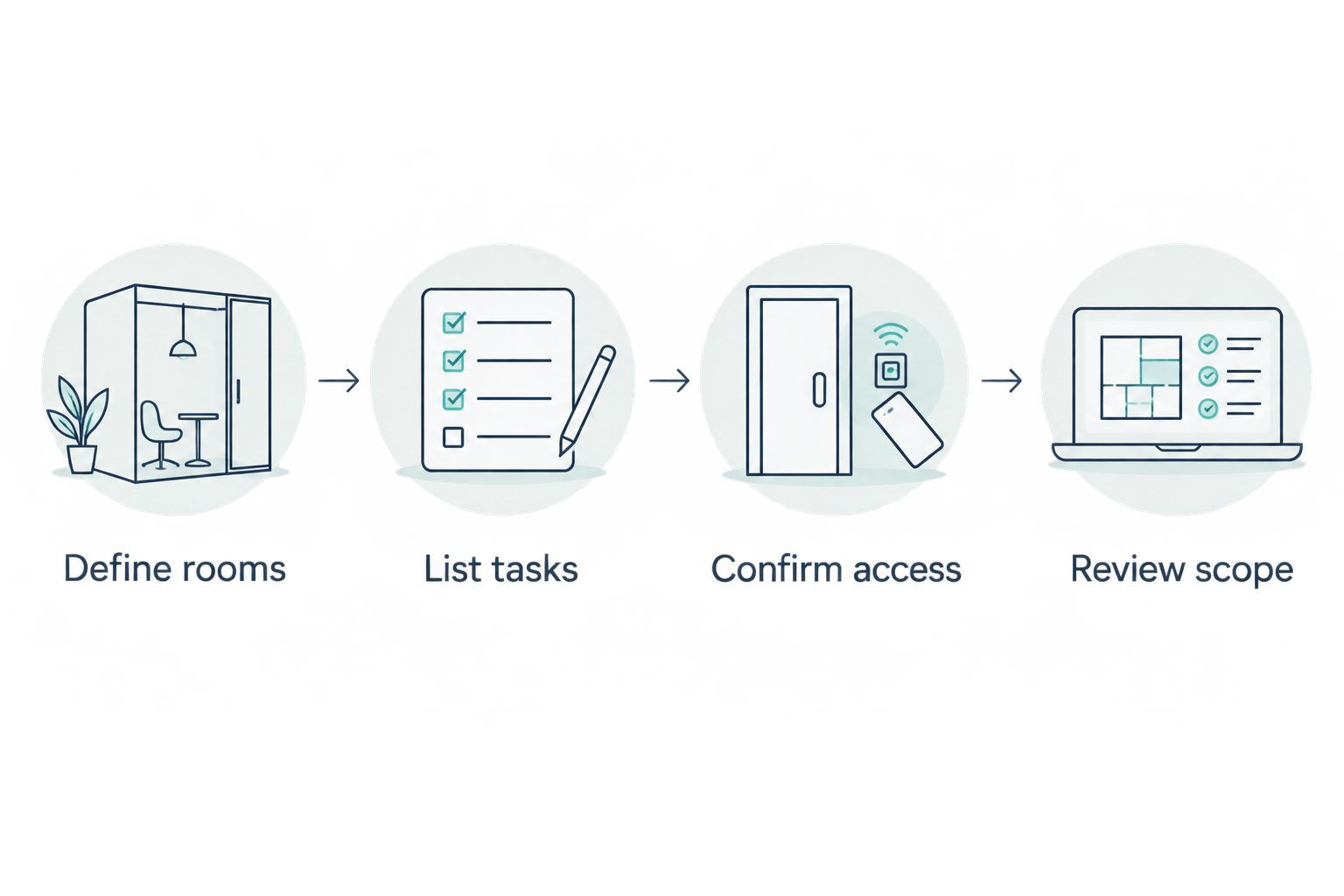
Confirm the task list and access arrangements before booking.
Ask who will carry out the work and how task instructions reach that team. Request confirmation of training relevant to the materials or equipment involved; do not infer credentials from a general service description.
Request your Tacoma cleaning quote
Share your rooms, priority tasks, access needs, and preferred schedule with Pureandcleancleaning.
Which checklist items should you choose?
Start with restrooms, entryways, shared touchpoints, and food-use areas. Add edges, fixtures, and interior glass when those tasks match the property's condition and the agreed scope.
The same decision applies to homes: bathrooms, entrances, handles, and kitchens form a practical starting list. Choose detail work deliberately rather than treating deep cleaning as permission to clean every object or inaccessible surface.
FAQ
What's the best commercial deep cleaning checklist for a Tacoma office?
The best checklist names restroom surfaces, entryways, floors, shared touchpoints, breakroom surfaces, accessible detail areas, and interior glass. Confirm materials, exclusions, access, and completion checks before booking.
Is commercial deep cleaning the same as regular janitorial cleaning?
Commercial deep cleaning and recurring janitorial cleaning should have separately defined scopes. State the extra detail tasks explicitly instead of assuming that the service name establishes what is included.
Can I use this checklist for house cleaning in Tacoma?
Yes, the checklist adapts to bathrooms, entry halls, handles, kitchens, trim, and mirrors in Tacoma homes. Replace workplace access instructions with household instructions about belongings, pets, occupied rooms, and delicate items.
Does deep cleaning include inside refrigerators and cabinets?
Do not assume appliance or cabinet interiors are included. Name each interior task, confirm that the provider accepts it, and agree on who removes food, dishes, and belongings.
How should employees or household members prepare for deep cleaning?
Clear the agreed work surfaces and remove personal belongings from cleaning areas. Confirm access, identify items that must remain untouched, and share relevant surface-care instructions.
Does commercial deep cleaning automatically include disinfection?
No, a cleaning scope does not automatically establish a disinfection service. Discuss any disinfection request separately, including suitable products and label directions, without assuming a health outcome.
How do I request commercial or residential cleaning in Tacoma in 2026?
Send Pureandcleancleaning the property type, rooms, priority surfaces, access restrictions, and preferred schedule. Ask for confirmation of the exact scope, preparation requirements, and exclusions before booking.
One last thing
The most useful checklist line is often an exclusion. Write down what must remain untouched—such as personal electronics, documents, stored food, or fragile displays—so your request defines boundaries as clearly as tasks.
Request a cleaning quote with your priority list attached, then confirm the scope before booking. That gives both your household and your workplace a clear next step.