
Best overall: aisle and floor care. Best for shared facilities: restroom cleaning. Best for shift handoffs: waste removal. This 2026 guide ranks warehouse cleaning checklist items by where they belong in your plan, what to specify, and what needs separate approval.
TL;DR
Best cleaning checklist Tacoma warehouses: start with aisle care, then assign restroom, waste, and shared-space responsibilities.
Pureandcleancleaning offers commercial janitorial services in Tacoma; confirm warehouse-specific tasks before booking.
Keep warehouse cleaning and house cleaning Tacoma checklists separate, even when both need floor and restroom care.
Every task needs a defined area, method, timing, owner, and completion check.
Why this matters
A warehouse checklist needs to distinguish routine cleaning from work around inventory, equipment, and loading activity. Otherwise, a request to clean the floors leaves unanswered questions about access, obstructions, and who moves what.
Pureandcleancleaning provides residential house cleaning and commercial janitorial services in Tacoma, Seattle, and Pierce County. For commercial cleaning services Tacoma businesses request in 2026, define the actual spaces and tasks before discussing a schedule. A general janitorial service description does not establish that specialized warehouse work is included.
What makes the best warehouse cleaning checklist?
Judge each checklist item against these criteria before adding it to your work order:
Clear boundaries: Name the room, aisle, surface, or collection point rather than saying everything.
Practical access: State when the area can be reached without working around active operations.
Surface suitability: Identify the material and use an appropriate cleaning method.
Assigned responsibility: Separate cleaning-team duties from tasks handled by warehouse staff.
Observable completion: Describe what someone checks afterward, such as an emptied bin or a cleared floor section.
The best warehouse cleaning checklist assigns responsibility as clearly as it describes the cleaning. A long list without ownership is harder to act on than a shorter list with clear boundaries.
Warehouse cleaning checklist items at a glance
This 2026 ranking puts routine floor access first, then separates shared-room care from tasks that need tighter boundaries. The order is a planning default, not permission to postpone an urgent site issue.
1. Aisle and floor care
Best for: Main circulation areas
Standout detail: Defines accessible floor sections
Key limitation: Does not include moving inventory unless agreed
2. Restroom cleaning
Best for: Shared facilities
Standout detail: Separates fixtures, supplies, and floors
Key limitation: Restocking responsibility needs confirmation
3. Waste removal
Best for: Shift handoffs
Standout detail: Names collection points and waste streams
Key limitation: Unknown or regulated materials need separate handling
4. Breakroom cleaning
Best for: Shared eating areas
Standout detail: Distinguishes surfaces from personal belongings
Key limitation: Appliance interiors require explicit scope
5. Office and touchpoint cleaning
Best for: Administrative spaces
Standout detail: Identifies surfaces staff share
Key limitation: Electronics and documents need boundaries
6. Entrance and loading-area housekeeping
Best for: Transitions between spaces
Standout detail: Separates entrances from active loading work
Key limitation: Dock equipment is not routine janitorial work
7. Accessible ledge and detail cleaning
Best for: Planned detail work
Standout detail: Records surfaces outside the floor routine
Key limitation: Elevated or equipment-related work needs separate assessment
1. Aisle and floor care: best for main circulation areas
Aisle and floor care belongs first because the checklist must say where cleaning can happen. Specify accessible floor sections, the surface material, and the appropriate debris-removal and cleaning methods. Keep inventory movement and equipment operation outside the cleaning assignment unless expressly agreed.
Aisle and floor care pros:
Gives the cleaning team a defined work area.
Separates loose debris removal from surface cleaning.
Makes blocked access visible before work begins.
Aisle and floor care cons:
Obstructed areas cannot be treated as completed areas.
An unspecified floor material leaves the cleaning method unresolved.
Best for: Main aisles, pedestrian routes, and accessible floor sections.
Verdict: Use first. Mark the boundaries on the checklist and identify who clears each area before cleaning starts.
2. Restroom cleaning: best for shared facilities
Restroom cleaning needs its own checklist rather than a single clean-bathroom instruction. List toilets, sinks, counters, mirrors, touchpoints, bins, and floors separately. State whether checking and replenishing consumables belongs to the cleaning team or your staff.
Restroom cleaning pros:
Makes individual fixtures easy to check.
Separates cleaning from supply management.
Supports a clear handoff between building users and cleaners.
Restroom cleaning cons:
Cleaning cannot resolve plumbing faults.
Replenishment depends on an agreed responsibility and accessible supplies.
Best for: Employee and visitor restroom areas.
Verdict: Use as a separate checklist. Record maintenance issues separately so an unresolved fixture fault does not become a repeated cleaning request.
3. Waste removal: best for shift handoffs
Waste removal works best when every collection point has a name or location. Define which ordinary waste and recycling streams the cleaning assignment includes, where collected materials go, and who handles anything outside that scope. Do not combine unknown liquids, sharp objects, or regulated materials with ordinary janitorial instructions.
Waste removal pros:
Clarifies who empties each collection point.
Keeps removal tasks distinct from sorting decisions.
Gives incoming staff a specific completion check.
Waste removal cons:
Unidentified materials require a separate decision.
Bin emptying does not automatically include bin washing.
Best for: Routine waste collection between work periods.
Verdict: Use with explicit exclusions. Name the collection points and disposal destination instead of writing remove all waste.
4. Breakroom cleaning: best for shared eating areas
Breakroom cleaning should identify counters, tables, sink areas, bin locations, and floors. Separate those surfaces from dishes, food containers, and personal belongings. Ask specifically about appliance exteriors and interiors rather than assuming both belong to the same task.
Breakroom cleaning pros:
Defines the shared surfaces that need attention.
Makes preparation responsibilities clear to employees.
Separates everyday cleaning from appliance detail work.
Breakroom cleaning cons:
Personal items can prevent access to surfaces.
Food disposal requires instructions from the business.
Best for: Shared kitchens and employee eating spaces.
Verdict: Use with a preparation rule. Ask employees to remove personal items from the agreed cleaning surfaces before the visit.
5. Office and touchpoint cleaning: best for administrative spaces
Warehouse offices need instructions for desks, meeting tables, door handles, switches, and other agreed shared surfaces. Tell the cleaning team which desks must remain untouched. Keep document handling and electronic equipment out of a general wipe-down instruction.
Office and touchpoint cleaning pros:
Separates administrative spaces from warehouse-floor work.
Identifies shared surfaces instead of relying on assumptions.
Gives staff clear preparation instructions.
Office and touchpoint cleaning cons:
Papers and equipment restrict access to desktops.
Sensitive finishes require suitable methods.
Best for: Reception areas, meeting rooms, and warehouse administration offices.
Verdict: Use with clear desk boundaries. Identify approved surfaces and leave document movement to authorized staff.
6. Entrance and loading-area housekeeping: best for transitions
Entrance housekeeping should distinguish interior entry floors and mats from active loading areas. Identify accessible thresholds and the person responsible for clearing packaging or other obstructions. Treat work around dock equipment, moving vehicles, and deliveries as a separate access discussion.
Entrance and loading-area housekeeping pros:
Defines the boundary between indoor cleaning and loading activity.
Identifies who prepares the area.
Keeps equipment-related tasks out of vague cleaning requests.
Entrance and loading-area housekeeping cons:
Delivery activity can interrupt access.
Cleaning does not replace equipment inspection or repair.
Best for: Entry transitions and agreed areas adjacent to loading operations.
Verdict: Hold until access is agreed. Do not schedule cleaning inside an active loading area without site-specific coordination.
7. Accessible ledge and detail cleaning: best for planned detail work
Detail cleaning covers agreed accessible ledges, baseboards, corners, and similar surfaces outside the main floor routine. Identify the surface and access requirements before adding the task. Elevated surfaces, machinery, and unknown residues require separate assessment rather than an expanded dust-everything instruction.
Accessible ledge and detail cleaning pros:
Makes overlooked surfaces part of a written plan.
Separates detail work from recurring floor tasks.
Gives the business a way to request specific additions.
Accessible ledge and detail cleaning cons:
Access requirements can change the assignment.
Unknown deposits cannot be treated as ordinary dust.
Best for: Clearly identified detail work on accessible building surfaces.
Verdict: Hold until the surface and method are confirmed. Keep specialized work separate from the routine checklist.
Turn the ranking into an assigned work order
For your 2026 checklist, use 6 fields per task: area, task, method, timing, owner, and completion check. These fields turn a general request into instructions someone can follow without guessing.
For example, the area might be the breakroom; the task might be cleaning the tables. Record the agreed surface-appropriate method, the access window, the responsible person or team, and the visible completion check. Keep approval for moving belongings separate.
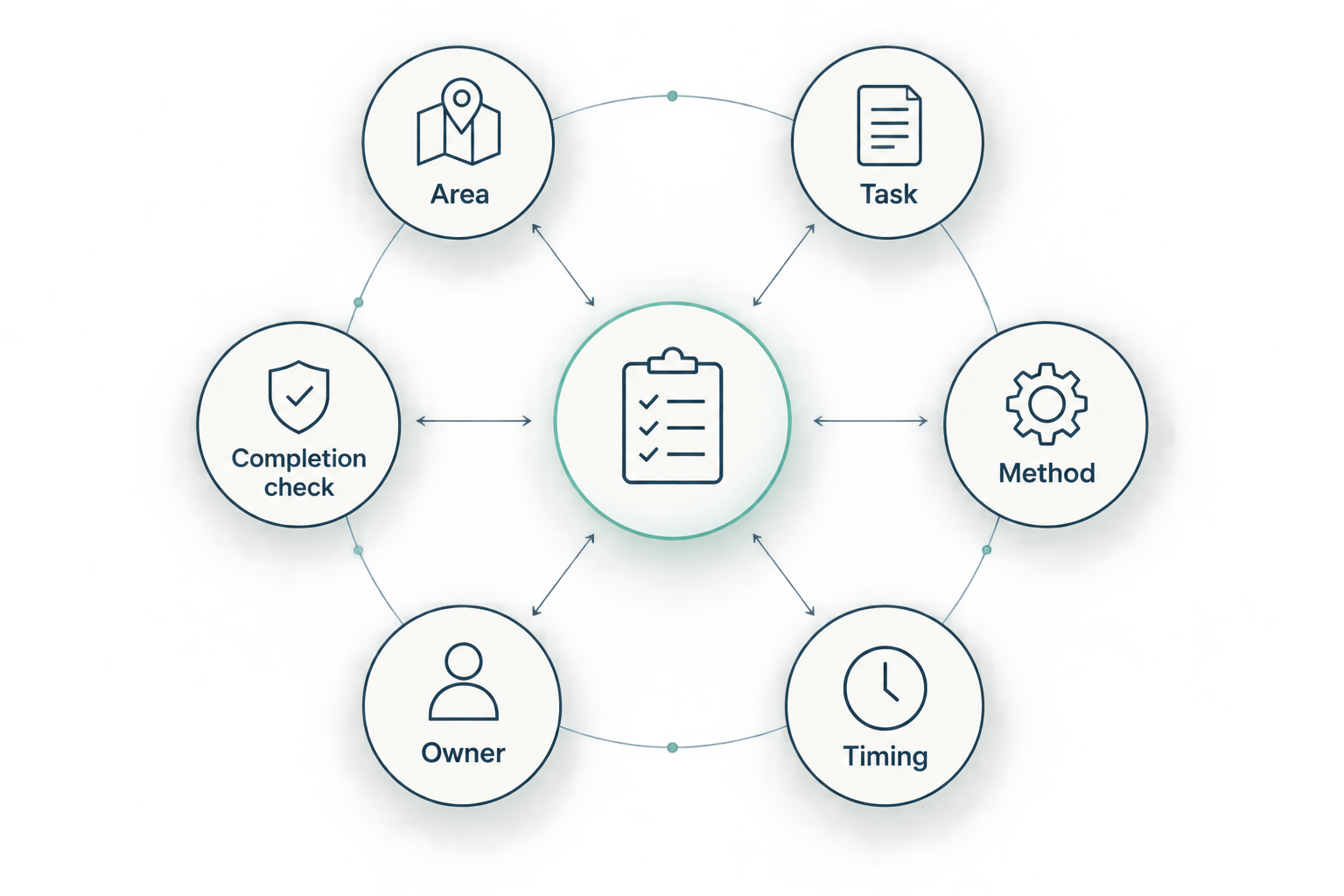
Define the assignment before choosing its cleaning schedule.
Do not mark a blocked area complete. Record the access problem and assign the next action to the person who can resolve it. That distinction keeps a cleaning record from concealing unfinished work.
Match timing to access and actual use
Choose cleaning windows around when each area is accessible. Restrooms, breakrooms, offices, and warehouse floors do not have to share the same schedule.
Before the visit: Clear agreed surfaces and identify restricted areas.
During the visit: Provide the designated contact for access questions.
After the visit: Check agreed tasks and record exceptions.
Review the schedule when your 2026 operations change, such as a different shift pattern or a revised storage layout. A calendar should follow the work areas, not remain fixed after the building's use changes.
Keep home and business cleaning requests distinct
House cleaning Tacoma requests deserve the same clarity as commercial assignments, but not the same checklist. At home, name the bedrooms, bathrooms, kitchen surfaces, and living areas you want addressed. Identify delicate surfaces, personal belongings, and any room that should remain untouched.
For commercial cleaning services Tacoma requests, describe employee facilities, offices, circulation areas, and operational restrictions instead. Warehouse access and household preparation are different discussions, even when both involve floors, sinks, and bins.
Keep 2 separate lists if you are arranging cleaning for both a home and a business. The home list should explain room-by-room priorities; the business list should explain area ownership, access windows, and agreed janitorial tasks. Neither list establishes that appliance interiors, elevated surfaces, or specialist cleaning are included.
Review the cleaning services offered by Pureandcleancleaning, then describe your property and requested tasks. Ask which work fits the service scope and what preparation is needed. Confirm team instructions and the point of contact rather than assuming every request is covered.
Request cleaning for your property
Describe your home or business, priority areas, access needs, and preferred schedule.
How the checklist items are ranked
The ranking follows clear boundaries, practical access, surface suitability, responsibility, and observable completion. Aisle care leads because it establishes accessible work areas; specialized detail work comes last because its scope needs more definition.
This is a task-priority guide, not a comparison of cleaning companies or a statement that every warehouse requires identical service. Change the order when an immediate site issue takes priority.
Which warehouse checklist should you choose?
Choose the aisle-and-floor checklist as your starting point, then add separate restroom, waste, and shared-space lists. Use the remaining items only where those areas exist and the work is agreed.
Pureandcleancleaning is a fit for Tacoma homeowners and businesses seeking residential cleaning or commercial janitorial services. For a warehouse request, confirm the specific tasks, access conditions, and exclusions before booking.
FAQ
What's the best cleaning checklist for a Tacoma warehouse?
The best warehouse cleaning checklist starts with defined floor areas and adds separate restroom, waste, breakroom, and office tasks. Assign an owner, timing, method, and completion check to every task.
How often should warehouse floors be cleaned?
Set warehouse floor-cleaning timing around actual use, surface needs, and access. Agree on a schedule for each area and revise it when operating conditions change.
Does commercial janitorial service include warehouse machinery?
Do not assume machinery cleaning is included in commercial janitorial service. Confirm equipment-related work separately and follow the site's authorization and manufacturer requirements.
What should employees do before warehouse cleaners arrive?
Employees should clear agreed surfaces, identify restricted areas, and arrange access through the designated site contact. Inventory movement, personal belongings, and document handling need explicit responsibility.
Can I use a house cleaning checklist for a warehouse office?
Use a house cleaning checklist only as a starting reference for shared tasks such as floors and bathroom surfaces. A warehouse office still needs separate instructions for documents, electronics, access, and business responsibilities.
Does restroom cleaning include replenishing supplies?
Restroom replenishment is included only when the service scope assigns that task. Confirm who provides supplies, where they are stored, and who checks them.
How do I request cleaning from Pureandcleancleaning?
Request a quote with your property type, location, priority areas, access requirements, and preferred schedule. Confirm warehouse-specific tasks and exclusions before booking commercial janitorial work.
One last thing
Add a place to record work that could not be completed. A checked box cannot explain a locked room, blocked aisle, or surface awaiting approval. Your 2026 cleaning plan needs an exception record as much as it needs a task list.