
Best overall: a mixed schedule with daily shared-area upkeep and scheduled cleaning visits. Best for busy, fully occupied offices: nightly cleaning. Best for lightly used offices and home offices: weekly cleaning with between-visit upkeep. This 2026 guide helps you choose a practical schedule for your Tacoma workplace without confusing visit frequency with cleaning scope.
TL;DR
The best office cleaning schedule Tacoma businesses can adopt matches tasks to occupancy, not just weekdays.
Choose a mixed schedule when restrooms, kitchens, and workstations need different cleaning frequencies.
Reserve weekly cleaning for lightly used offices with someone responsible for between-visit upkeep.
Pureandcleancleaning provides residential house cleaning and commercial janitorial services in Tacoma, Seattle, and Pierce County.
Why this matters
An office can have clean conference rooms and an overflowing kitchen bin on the same afternoon. Booking more visits does not fix an incomplete task list. You need to decide what gets cleaned, when it gets cleaned, and who handles anything between visits.
For your 2026 plan, start with actual attendance and room use rather than the number of desks. Review the available cleaning services, then describe your building and priorities before agreeing to a schedule. The options below are planning recommendations, not a statement that every schedule or task is offered.
What makes the best office cleaning schedule?
Occupancy fit: Base the schedule on who actually uses the office, including visitors and shared workstations.
Room-level priorities: Give restrooms, kitchens, entrances, and meeting rooms their own task frequencies.
Clear ownership: Assign between-visit tasks to a named person or team rather than assuming someone will handle them.
Workday compatibility: Match the service window to meetings, calls, building access, and closing procedures.
Defined scope: Separate routine upkeep from periodic detail work, and confirm both before booking.
Reviewability: Use missed tasks, visible buildup, and changes in attendance to decide whether the schedule needs adjustment.
Office cleaning schedules at a glance
The frequencies below are suggested starting points. Choose a schedule only after deciding which rooms and tasks each visit includes.
Mixed schedule
Best for: Offices with uneven room use
Standout feature: Different frequencies for different zones
Key limitation: Requires clear task ownership
Nightly cleaning
Best for: Busy offices occupied throughout the week
Standout feature: Cleaning follows each occupied workday
Key limitation: Access and closing arrangements need coordination
Selected-weekday cleaning
Best for: Hybrid teams with predictable office days
Standout feature: Visits follow attendance peaks
Key limitation: Gaps need between-visit upkeep
Weekly cleaning
Best for: Lightly used offices and home offices
Standout feature: A simple recurring reset
Key limitation: Not enough by itself for busy shared areas
Daytime maintenance
Best for: Workplaces needing attention during business hours
Standout feature: Problems can be addressed while rooms are in use
Key limitation: Cleaning activity can interrupt work
1. Mixed schedule: best for offices with uneven room use
A mixed schedule assigns frequency by task instead of treating the whole office as one space. Shared areas receive daily attention, while workstations and detail work follow separate schedules. This is the strongest default when different rooms have different demands.
For example, you can plan 2 cleaning visits per week while assigning daily kitchen and restroom checks internally. That is a proposed arrangement to discuss with a provider, not a universal minimum.
Use these zones to build the task list:
Shared areas: Check waste, spills, restroom supplies, and kitchen surfaces on occupied days.
Workstations: Schedule accessible desk surfaces and surrounding floors around attendance and desk-clearance rules.
Detail work: Separately arrange tasks such as baseboards or other less-frequent work, confirming what is included.
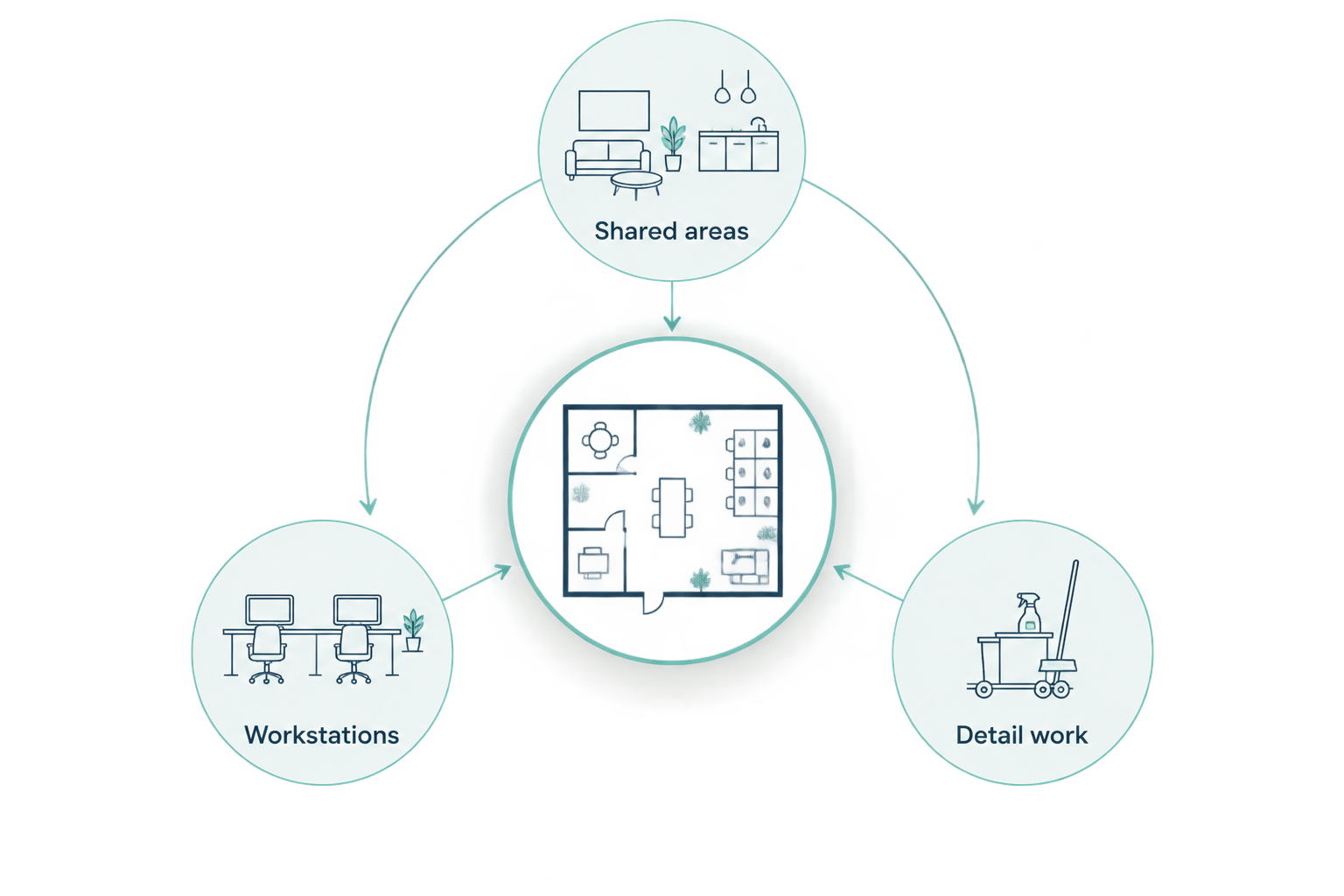
Assign cleaning frequency by room and task rather than giving every area the same schedule.
Mixed schedule pros:
Separates daily necessities from less-frequent tasks.
Lets you assign attention to heavily used rooms.
Gives staff and the provider distinct responsibilities.
Mixed schedule cons:
Needs a written checklist to prevent gaps.
Fails when internal responsibilities remain unassigned.
Best for: Offices where kitchens, restrooms, desks, and meeting rooms have different usage patterns.
Verdict: Buy into a mixed schedule as your default planning approach.
2. Nightly cleaning: best for busy, fully occupied offices
Nightly cleaning places routine service after the working day. For an office occupied Monday through Friday, that means a proposed schedule of 5 visits per week, with separate arrangements for weekend use.
Start the discussion with occupied days, not the word nightly. Explain when the final employee leaves, which rooms remain in use, and how the cleaning team would enter and secure the space.
Nightly cleaning pros:
Creates a recurring reset after each occupied workday.
Keeps scheduled work outside normal meetings and calls.
Provides frequent opportunities to complete routine tasks.
Nightly cleaning cons:
Requires dependable entry and closing instructions.
Applies the same visit frequency even when some areas see little use.
Does not automatically include detail work or specialist tasks.
Best for: Offices with consistent weekday attendance and busy shared spaces.
When planning nightly cleaning in 2026, identify any late meetings or evening occupants before agreeing to a service window. A locked meeting room is still an uncleaned meeting room, regardless of the frequency on the calendar.
Verdict: Buy when each occupied workday creates a clear cleaning need.
3. Selected-weekday cleaning: best for predictable hybrid attendance
Selected-weekday cleaning places visits around the days your team uses the office most. A starting proposal of 3 visits per week suits a discussion about an office with concentrated attendance, but room conditions should determine the final plan.
If your busiest days are Tuesday through Thursday, explain that pattern before choosing service days. A visit scheduled before the attendance peak serves a different purpose from one scheduled after it.
Selected-weekday cleaning pros:
Connects service days to actual office use.
Makes recurring responsibilities easy to put on a calendar.
Leaves room for different frequencies in low-use areas.
Selected-weekday cleaning cons:
Attendance changes can make the calendar outdated.
Food waste and spills still need attention between visits.
Events can create needs outside the regular schedule.
Best for: Hybrid teams with stable, known attendance peaks.
Assign a person to report changed office days and upcoming gatherings. Otherwise, the cleaning calendar can remain fixed while the building's use changes around it.
Verdict: Buy when attendance is predictable; hold until you understand the pattern if it is not.
4. Weekly cleaning: best for lightly used offices and home offices
Weekly cleaning provides one recurring visit for an office with limited use and manageable between-visit tasks. A proposed schedule of 1 visit per week is a starting point, not proof that the space needs no other attention.
Home offices belong in this discussion too. A desk in a spare room, a client-facing room at home, and a shared household workspace each need a clear boundary between office tasks and general house cleaning.
Weekly cleaning pros:
Creates a straightforward recurring routine.
Fits planning for spaces used only occasionally.
Helps homeowners coordinate office cleaning with household priorities.
Weekly cleaning cons:
Leaves several days of upkeep to the occupants.
Is a poor standalone choice for heavily used shared facilities.
Requires explicit agreement about personal desks and equipment.
Best for: Low-use professional offices and home offices with active between-visit upkeep.
For residential cleaning, specify whether the office floor, accessible furniture, adjoining bathroom, or entryway belongs in the requested scope. Do not assume a house-cleaning visit includes handling papers, computer equipment, or every item on a desk.
Verdict: Buy for genuinely light use; skip as a standalone plan for a busy office.
5. Daytime maintenance: best for attention during business hours
Daytime maintenance addresses agreed tasks while people use the building. Think of restroom checks, waste checks, and spot cleaning rather than assuming every room receives a complete clean during working hours.
This arrangement needs boundaries. Identify spaces that must remain quiet, rooms that require permission to enter, and the person authorized to request additional attention.
Daytime maintenance pros:
Allows agreed issues to be addressed during occupancy.
Gives an on-site contact a direct coordination role.
Supports targeted attention to frequently used shared areas.
Daytime maintenance cons:
Equipment and movement can interrupt work.
Occupied rooms restrict access to surfaces and floors.
Periodic or after-hours work can still be necessary.
Best for: Workplaces where shared spaces need attention before the business day ends.
Daytime maintenance is not the same as emergency response. Confirm the agreed tasks and service window rather than assuming every new request falls within the arrangement.
Verdict: Buy for a defined daytime need; skip when quiet, uninterrupted occupancy is the priority.
How these schedules are ranked
The 2026 ranking prioritizes occupancy fit, room-level needs, clear ownership, workday compatibility, and defined scope. A mixed schedule ranks first because it lets you assign different frequencies to different tasks instead of forcing every room into the same pattern.
Nightly, selected-weekday, weekly, and daytime schedules each serve a narrower use case. The ranking is a planning guide, not a claim based on measured results at Tacoma properties.
Prepare a clear request for your home or workplace
For commercial cleaning services in Tacoma and house cleaning in Tacoma, the next step is the same: describe the space, list the priorities, and confirm responsibilities. Pureandcleancleaning is best for readers seeking a provider of residential cleaning or commercial janitorial services in Tacoma.
Use this preparation sequence for either setting:
List the spaces. Businesses should identify offices, restrooms, kitchens, and shared rooms. Homeowners should identify bedrooms, bathrooms, living areas, and any home office included in the request.
Describe actual use. Share your office attendance pattern or household routine, including rooms that are occupied during the proposed visit.
Set priorities. Identify the tasks that matter most. Separate routine cleaning from requests that need individual confirmation.
Explain access. Discuss entry, parking instructions, pets, locked rooms, and who can answer questions.
Confirm the scope. Agree on included tasks, exclusions, supplies, equipment, and how schedule changes are communicated.
Ask how team members receive your site instructions and how questions or missed tasks are reported. Clear answers give you something concrete to assess; reassuring language alone does not define reliable service.
You can request a quote with your preferred frequency and task list. Ask which arrangements are available before treating a proposed schedule as a booking.
Which office cleaning schedule should you choose?
Choose a mixed schedule unless your building has a clear reason for another approach. Put daily shared-area tasks on one list and scheduled cleaning tasks on another. Name the person responsible for each.
For your 2026 calendar, choose nightly cleaning when every occupied day warrants a reset, selected weekdays when attendance is concentrated, and weekly cleaning when use is genuinely light. Add daytime maintenance only when there is a defined need during business hours.
Homeowners should apply the same logic without turning a home into a commercial checklist. Keep household priorities visible, explain how the home office is used, and confirm the residential scope separately.
FAQ
What's the best office cleaning schedule for a Tacoma business?
A mixed schedule is the best default for an office whose rooms have different usage patterns. Assign daily shared-area upkeep separately from scheduled workstation cleaning and periodic detail work, then confirm responsibilities.
Should an office be cleaned every night?
Nightly cleaning fits offices where each occupied workday creates a clear cleaning need. Lightly used rooms do not automatically need the same frequency as busy restrooms, kitchens, or entrances.
Is weekly cleaning enough for a small office?
Weekly cleaning fits a lightly used office only when someone handles necessary tasks between visits. Office size alone does not determine frequency; attendance, food waste, spills, and shared-room use matter too.
When should a hybrid office schedule cleaning visits?
A hybrid office should place cleaning visits around its actual attendance peaks. Explain which days are busiest and decide whether visits should prepare the space before occupancy or reset it afterward.
Can I include a home office in house cleaning in Tacoma?
Ask to include the home office when discussing your residential cleaning scope. Identify accessible surfaces and floors, and confirm how papers, personal items, and electronics should be handled.
What should I prepare before requesting commercial cleaning services in Tacoma?
Prepare a room list, attendance pattern, task priorities, preferred service window, and access instructions. Ask the provider to confirm included work, exclusions, and responsibilities between visits.
Does Pureandcleancleaning serve both homes and businesses?
Pureandcleancleaning provides residential house cleaning and commercial janitorial services for homes and businesses in Tacoma, Seattle, and Pierce County, Washington. Describe your property and requested tasks when asking about a suitable arrangement.
One last thing
Before approving your 2026 schedule, ask one question: Who handles a kitchen spill the morning after a cleaning visit? If nobody owns that task, your schedule has a gap that another recurring calendar entry will not resolve. Assign between-visit responsibilities before you finalize the plan.