
Best overall: shared-equipment cleaning. Best for entrances and movement areas: floor care. Best for washrooms: restroom cleaning. This 2026 guide ranks six checklist priorities for Tacoma gyms and studios; Pureandcleancleaning provides residential house cleaning and commercial janitorial services in Tacoma, Seattle, and Pierce County.
TL;DR
The best cleaning checklist for Tacoma gyms and studios starts with shared equipment and clearly assigned responsibilities.
Match floor care, restroom cleaning, and touchpoint tasks to your facility’s actual use.
Pureandcleancleaning provides commercial janitorial services and residential house cleaning in Tacoma.
Confirm equipment exclusions, access arrangements, staff training, and completion checks before booking.
Why this matters
A checklist fails when it names a room but never defines the work. Writing down “studio cleaned” does not tell you whether anyone addressed equipment grips, floor edges, door handles, or waste containers.
For your 2026 cleaning plan, separate tasks employees handle during operating hours from work assigned to a cleaning provider. The same distinction helps at home: clearing toys and personal belongings is different from cleaning the surfaces underneath them.
Pureandcleancleaning is a local service option for Tacoma homeowners and businesses seeking house cleaning or commercial janitorial services. For a gym or studio, confirm the proposed work covers your specific facility rather than assuming every commercial task is included.
What makes the best gym and studio cleaning checklist?
Use these criteria before choosing checklist items or approving a cleaning scope:
Surface specificity: Identify the equipment part, floor material, fixture, or furnishing—not just the room.
Clear ownership: Assign each task to your staff, members where appropriate, or the cleaning provider.
Use-based scheduling: Connect work to operating hours, class changes, and observed conditions.
Material compatibility: Follow equipment instructions and cleaning-product labels rather than using one product everywhere.
Observable completion: Describe what someone can inspect without implying invisible health outcomes.
Explicit exclusions: Record tasks that require separate approval, specialist handling, or a different service.
The same criteria apply when comparing house cleaning Tacoma services. A residential checklist needs clear boundaries around personal belongings and delicate finishes; a commercial checklist also needs boundaries around shared equipment and business access.
Gym and studio checklist priorities at a glance
The order below is a planning recommendation, not a claim that every facility has identical needs. Move a task higher when a walkthrough identifies an immediate problem.
1
Checklist item: Shared-equipment cleaning
Best for: Equipment-based workouts
Standout feature: Names the parts people handle
Key limitation: Requires equipment-specific instructions
2
Checklist item: Floor and entrance care
Best for: Movement areas and tracked-in debris
Standout feature: Separates entryways from exercise floors
Key limitation: One method does not suit every floor
3
Checklist item: Restroom cleaning
Best for: Washrooms and changing areas
Standout feature: Separates cleaning from supply checks
Key limitation: Showers and laundry need explicit scope
4
Checklist item: Shared-touchpoint cleaning
Best for: Reception and common areas
Standout feature: Captures small surfaces easily overlooked
Key limitation: Does not replace equipment cleaning
5
Checklist item: Waste and room reset
Best for: Class transitions and closing
Standout feature: Makes reset responsibilities visible
Key limitation: Does not address underlying surface buildup
6
Checklist item: Completion and access checks
Best for: Service accountability
Standout feature: Records unfinished work and handoffs
Key limitation: A checked box alone proves little
1. Shared-equipment cleaning: best for equipment-based workouts
Start with the parts of equipment that users actually handle. Depending on your facility, the list can name grips, adjustment controls, bench surfaces, and shared accessories; include only equipment you have.
Do not assume a general commercial cleaning agreement covers exercise machines or specialty studio equipment. Ask who supplies the instructions and who approves products before work begins.
Shared-equipment cleaning pros:
Turns a broad instruction into identifiable tasks.
Separates member wipe-down expectations from provider responsibilities.
Gives staff a clear way to report unfinished work.
Shared-equipment cleaning cons:
Different materials require different care instructions.
Internal mechanisms and repairs belong outside an ordinary surface-cleaning checklist.
Best for: Gyms and studios with shared workout equipment.
Home equivalent: Apply the same detail to a household exercise area. Identify the equipment surfaces you want addressed, then confirm whether the house-cleaning scope includes them; do not treat equipment maintenance as routine room cleaning.
Verdict: Buy — approve equipment cleaning only with written surface boundaries and responsibilities.
2. Floor and entrance care: best for movement areas
Separate entrances, circulation routes, and exercise floors instead of giving them one blanket instruction. List the floor materials and ask which cleaning methods match their care requirements.
Schedule work so people do not need to cross an area while it is being cleaned. Record how staff should handle spills between provider visits rather than leaving that responsibility unassigned.
Floor and entrance care pros:
Distinguishes tracked-in debris from exercise-area cleaning.
Makes floor edges and accessible corners part of the scope.
Connects cleaning work with room access and class schedules.
Floor and entrance care cons:
Furniture and equipment can limit access.
A routine floor task does not automatically include restoration or specialty treatments.
Best for: Studios with open movement areas and facilities with busy entrances.
Home equivalent: Separate entry floors from living spaces and bedrooms. Tell your house cleaner about delicate flooring, rugs, and areas blocked by furniture; agree on what needs moving before the visit.
Verdict: Buy — select floor care defined by material and access, not a vague promise to mop everywhere.
3. Restroom cleaning: best for washrooms and changing areas
Name toilets, sinks, faucets, mirrors, accessible counters, and floors separately. Add changing benches, showers, or lockers only when they exist and the provider has agreed to clean them.
Keep supply checks distinct from cleaning tasks. Confirm who provides and replenishes soap, paper products, and liners instead of assuming replenishment is included.
Restroom cleaning pros:
Makes fixture-level expectations clear.
Separates cleaning work from supply management.
Helps staff identify an unfinished task without rejecting the entire visit.
Restroom cleaning cons:
Laundry and shower detailing require separate confirmation.
Plumbing problems are not cleaning tasks.
Best for: Facilities with member washrooms or changing rooms.
Home equivalent: A household bathroom checklist needs the same precision. Identify the shower, tub, toilet, sink, mirror, and floor, then ask about buildup or delicate finishes before booking; keep toiletries out of the agreed work areas.
Verdict: Buy — approve restroom cleaning with fixtures, supplies, and exclusions listed separately.
4. Shared-touchpoint cleaning: best for reception and common areas
List door handles, accessible switches, reception counters, and other frequently handled surfaces in your actual layout. Treat electronics separately and follow their care instructions.
A touchpoint checklist supplements room cleaning. It does not mean that workout equipment, seating, or every object behind reception is included.
Shared-touchpoint cleaning pros:
Captures small surfaces that room-level checklists overlook.
Gives reception staff a specific handoff list.
Applies across entrances, offices, and shared corridors.
Shared-touchpoint cleaning cons:
Electronics require particular care.
Cleaning these surfaces does not establish that a space is disinfected.
Best for: Studios with reception desks, shared doors, and administrative areas.
Home equivalent: Identify household door handles, switches, stair rails, and accessible counters. Agree on boundaries around computers, personal papers, and decorative objects rather than expecting a cleaner to move everything.
Verdict: Buy — include named touchpoints while keeping electronics and private materials clearly defined.
5. Waste and room reset: best for class transitions
Specify which containers need emptying, where collected waste goes, and who supplies replacement liners. Keep ordinary waste separate from anything requiring special handling.
Define the reset, too: which movable items return to their places, which areas remain clear, and which belongings staff handle. A tidy-looking room is not evidence that its surfaces were cleaned.
Waste and room reset pros:
Separates removing waste from cleaning containers.
Gives staff and cleaners consistent placement instructions.
Makes end-of-day responsibilities easier to review.
Waste and room reset cons:
Resetting a room does not remove surface buildup.
Personal belongings can prevent access to scheduled work.
Best for: Class-based studios and facilities with shared storage areas.
Home equivalent: Decide who handles household rubbish, recycling, toys, and loose belongings. Clearing a countertop before a house-cleaning visit gives access to the surface; organizing cupboards is a separate request unless expressly agreed.
Verdict: Buy — include a reset only when the task defines waste handling and item placement.
6. Completion and access checks: best for accountability
Close the checklist with a record of completed tasks, exceptions, and access issues. Replace a single “done” box with enough detail to identify what remains unfinished.
For your 2026 service agreement, ask how concerns reach the responsible person. Confirm key or entry arrangements, restricted areas, and the process for reporting an item that could not be cleaned.
Completion and access checks pros:
Distinguishes completed work from blocked access.
Gives recurring concerns a place in the service discussion.
Connects the cleaning visit to an accountable handoff.
Completion and access checks cons:
A checklist needs review to remain useful.
Written records do not replace checking the agreed work.
Best for: Owners and managers coordinating staff and an outside cleaning provider.
Home equivalent: Agree on household entry, pets, private rooms, and how to report concerns. Tell the cleaner about changed access or newly restricted spaces before the appointment, not after an expected task is missed.
Verdict: Buy — require a clear completion record rather than relying on an unexplained checkmark.
Turn the priorities into a usable cleaning plan
Give each task 3 fields: Surface, Task, and Owner. Add timing and exceptions alongside them so a staff member or cleaning provider can understand the instruction without guessing.
Surface: Name the specific object or area.
Task: Describe the agreed cleaning action and applicable instructions.
Owner: Identify who handles the work and reports exceptions.
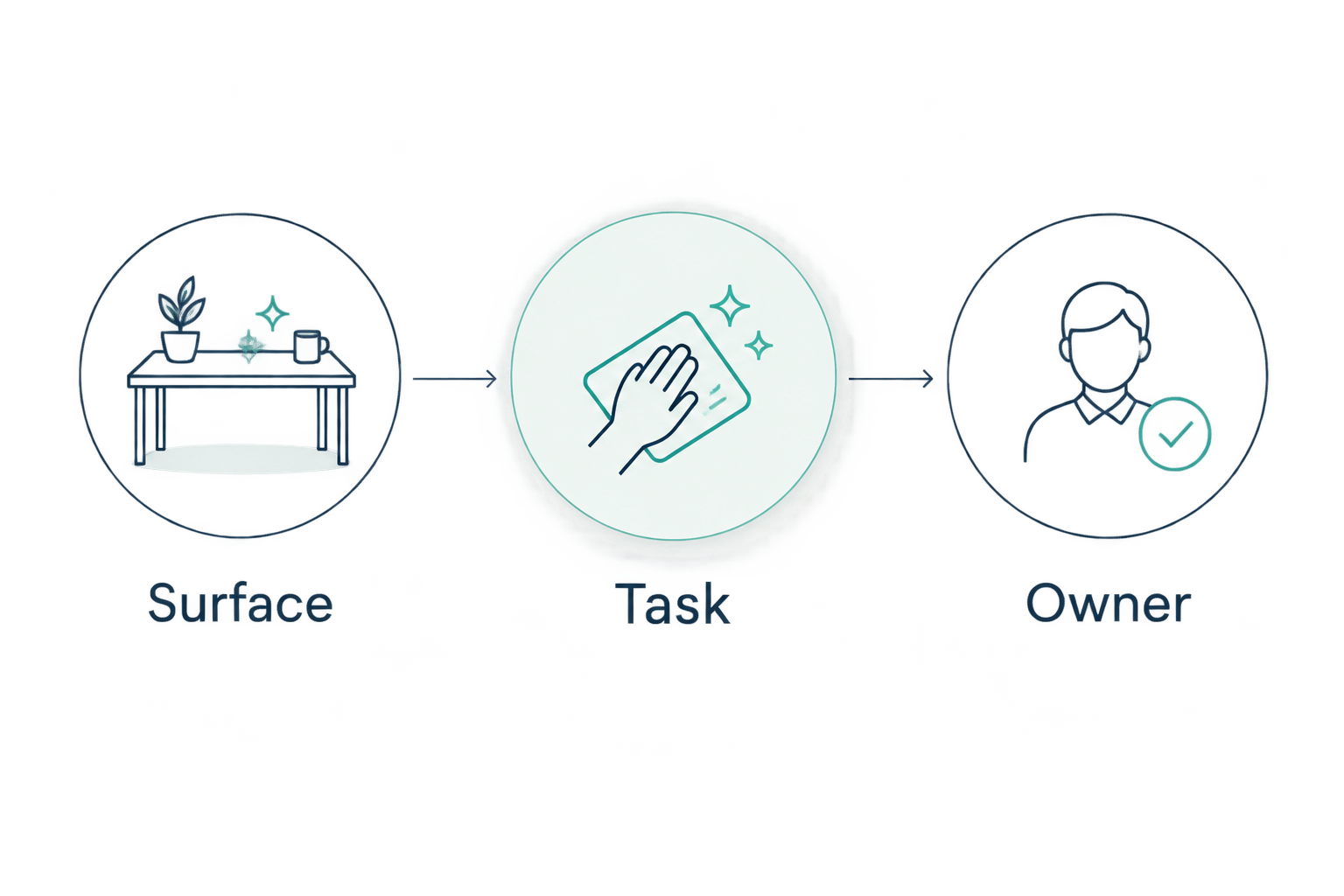
A useful checklist identifies the surface, the work, and the person responsible.
Use 2 walkthroughs as a practical starting process: one before agreeing on the scope and one after the first service. During the first, identify surfaces and exclusions; during the second, compare the completed work with the written task list.
For residential cleaning, follow the same process room by room. For commercial cleaning services Tacoma businesses are considering, add operating hours, class transitions, staff responsibilities, and restricted areas.
How the checklist items are ranked
This 2026 ranking puts specific cleaning tasks before administrative checks: equipment, floors, restrooms, shared touchpoints, waste, and completion. Each item earns its place through surface specificity, clear ownership, scheduling, material care, and observable completion—not unsupported claims about health outcomes.
Use the cleaning services page to start a scope discussion with Pureandcleancleaning. Ask about team training for the agreed tasks, equipment exclusions, access arrangements, and how concerns are handled; confirm the answers before booking.
Request your cleaning quote
Describe your Tacoma home, gym, or studio and the tasks you want included.
Which checklist should you choose?
Choose shared-equipment cleaning as the default starting point for an equipment-based facility, then add every other relevant category. A movement studio without shared machines should start with its exercise floor instead; a facility without showers should not carry shower tasks copied from someone else’s template.
For homeowners, start with the rooms and surfaces you actually want cleaned. Pureandcleancleaning offers both house cleaning and commercial janitorial services, so describe the property and requested work clearly rather than relying on a generic checklist title.
FAQ
What’s the best cleaning checklist for Tacoma gyms and studios?
The best checklist names shared equipment, floors, restrooms, touchpoints, waste tasks, and completion checks that apply to your facility. Give each task an owner and confirm the cleaning scope before booking.
What should a small studio prioritize in 2026?
A small studio should prioritize the surfaces used during its actual classes, along with its entrance and restroom. Start with equipment cleaning for equipment-based sessions or floor care for an open movement studio.
Should gym staff or a cleaning company clean equipment?
Assign equipment cleaning explicitly rather than assuming either party handles it. Follow equipment care instructions and distinguish work during operating hours from the provider’s agreed service.
Does regular cleaning mean a studio is disinfected?
No, cleaning and disinfecting are different tasks. If disinfection is requested, confirm that it is included and that the product label and surface instructions are followed.
How often should a gym or studio be cleaned?
Set the schedule around facility use, operating hours, and the agreed tasks. Assign responsibility for spills and other issues that arise between scheduled cleaning visits.
Can I use a house-cleaning checklist for a studio?
A house-cleaning checklist provides a starting point for bathrooms, floors, and accessible surfaces, but it is not a complete studio scope. Add shared equipment, business access, class schedules, and staff handoffs.
What should I send when requesting a cleaning quote?
Send the property type, location, room or area list, floor materials, access arrangements, and requested tasks. Identify equipment, showers, restricted spaces, or special-care surfaces so the provider can confirm the proposed scope.
One last thing
Keep a short not included list beside your 2026 cleaning checklist. A clearly excluded task is easier to discuss than work everyone assumed someone else would handle; review that list whenever equipment, rooms, or household needs change.