
Best overall: entrance and sales-floor care. Best for shared surfaces: checkout cleaning. Best for overlooked spaces: fitting-room checks. This 2026 guide ranks retail cleaning checklist items for Tacoma stores and shows you how to assign, schedule, and verify the work.
TL;DR
The best cleaning checklist Tacoma retail stores can use starts with entrances, sales floors, checkout areas, and restrooms.
Pureandcleancleaning provides commercial cleaning services and house cleaning for Tacoma homes and businesses.
Give each cleaning task a named owner, a suitable method, and a completion check.
Separate employee upkeep from contracted cleaning so neither team assumes the other handles it.
Why this matters
A retail checklist needs to tell your team what to do, not simply say that the store should look clean. An entrance mat, payment terminal, fitting-room mirror, and restroom fixture each need a different instruction.
For your 2026 plan, separate work during business hours from work that needs clear floors or restricted access. Compare your checklist with the cleaning services you intend to request, then confirm the actual scope before booking.
Pureandcleancleaning serves Tacoma homeowners and businesses seeking house cleaning and commercial cleaning services. For a retail store, the next step is to describe your premises and ask which checklist tasks can be included.
What makes the best retail cleaning checklist
Use these criteria before deciding which tasks belong at the top:
Visible priority: Start with the areas customers encounter and the surfaces staff use throughout the day.
Surface suitability: Match products and methods to flooring, fixtures, electronics, and manufacturer instructions.
Clear ownership: Name the employee role or contracted team responsible for each task.
Workable timing: Separate opening checks, trading-hour upkeep, and after-closing cleaning.
Verifiable completion: Describe what the person checking the task should inspect.
Defined boundaries: State what requires permission, specialist attention, or a separate service agreement.
A useful task reads like an instruction: remove loose debris from the entrance mat and inspect underneath it. An entry that only says “entrance” leaves the method and finish undefined.
Retail cleaning checklist at a glance
The ranking below prioritizes general retail spaces. Move a task higher when your layout, facilities, or operating requirements make it more relevant.
1. Entrance and sales-floor care
Best for: Everyday customer routes
Standout instruction: Check mats, debris, spills, and floor condition
Key limitation: Needs attention between scheduled cleans
2. Checkout cleaning
Best for: Shared customer-facing surfaces
Standout instruction: Separate counters from payment electronics
Key limitation: Device instructions control the method
3. Restroom care
Best for: Stores with customer or staff facilities
Standout instruction: Check fixtures, floors, waste, and supplies separately
Key limitation: A completed clean does not replace later checks
4. Fitting-room checks
Best for: Clothing and apparel stores
Standout instruction: Inspect every room, including behind doors
Key limitation: Merchandising still needs a separate owner
5. Glass and mirror cleaning
Best for: Visibility and presentation
Standout instruction: Inspect from both sides where accessible
Key limitation: Height and access can restrict scope
6. Staff-area cleaning
Best for: Breakrooms and shared workspaces
Standout instruction: Separate personal items from cleanable surfaces
Key limitation: Staff must handle their belongings
7. Waste and recycling checks
Best for: Keeping collection points orderly
Standout instruction: Check containers and the surrounding floor
Key limitation: Disposal rules differ by waste type
8. Detail-cleaning rotation
Best for: Edges and overlooked surfaces
Standout instruction: Name specific fixtures for each rotation
Key limitation: Requires time beyond routine touch-ups
1. Entrance and sales-floor care: best for customer routes
Put entrances and main aisles first because they form the route through your store. List mat care, loose-debris removal, spill response, and floor cleaning as separate tasks rather than one broad instruction.
Choose a method suited to the actual flooring. Do not treat sealed hard flooring, carpet, and specialty finishes as interchangeable.
Entrance and sales-floor care pros:
Gives opening staff a clear starting point.
Connects entrance upkeep with the main sales area.
Makes spills and damaged mats visible during checks.
Entrance and sales-floor care cons:
An opening clean cannot address later spills.
Floor work needs coordination with customer access.
Best for: Stores with a shared entrance and defined shopping aisles.
Verdict: Make this your default first checklist item.
2. Checkout cleaning: best for shared surfaces
Write separate instructions for checkout counters, bagging areas, nearby handles, and payment devices. Clear movable items only with permission, then return them to their agreed positions.
Follow the payment-device manufacturer's cleaning instructions. Do not make spraying every checkout surface a blanket rule.
Checkout cleaning pros:
Defines the boundary between counters and electronics.
Gives staff a repeatable handoff task.
Includes bagging surfaces that broad lists overlook.
Checkout cleaning cons:
Active transactions interrupt access.
Electronics need device-specific instructions.
Best for: Stores where several employees share a checkout station.
Verdict: Keep checkout care separate from general dusting.
3. Restroom care: best for stores with shared facilities
Break restroom work into fixtures, touchpoints, floors, waste containers, and supply checks. Record an issue when a fixture needs repair rather than marking it as a cleaning task that never gets finished.
Keep cleaning equipment organized by its intended area. Follow product-label directions, including any stated contact time when using a disinfectant.
Restroom care pros:
Separates cleaning from supply replenishment.
Makes maintenance issues easier to report.
Gives the checker specific surfaces to inspect.
Restroom care cons:
Facilities need checks after the cleaning visit.
Repairs fall outside ordinary cleaning instructions.
Best for: Retail premises with customer or employee restrooms.
Verdict: Include both scheduled cleaning and operating-hour checks.
4. Fitting-room checks: best for apparel stores
Inspect each fitting room for floor debris, mirror marks, discarded packaging, and items left behind. Include the space behind the door and beneath seating where accessible.
Assign clothing recovery to store staff unless another arrangement is explicitly agreed. Cleaning and returning garments to the sales floor are different responsibilities.
Fitting-room checks pros:
Gives every room an individual check.
Includes concealed corners and accessible seating areas.
Separates merchandise handling from cleaning.
Fitting-room checks cons:
Occupied rooms cannot be checked immediately.
Left-behind merchandise blocks access to surfaces.
Best for: Clothing stores with enclosed fitting rooms.
Verdict: Use a room-by-room check, not a single area checkbox.
5. Glass and mirror cleaning: best for store presentation
Name the glass you want cleaned: entrance doors, interior partitions, display glass, or mirrors. Specify accessible sides and distinguish spot cleaning from a full-surface clean.
Ask about elevated or difficult-to-reach glass separately. A request to clean the entrance door does not define the scope for every window in the building.
Glass and mirror cleaning pros:
Targets fingerprints on visible surfaces.
Distinguishes touch-ups from full cleaning.
Makes access requirements explicit.
Glass and mirror cleaning cons:
High glass requires separate access planning.
Displays can prevent access to interior surfaces.
Best for: Stores with glass entrances, display cases, or customer mirrors.
Verdict: Specify the surface and accessible side before scheduling.
6. Staff-area cleaning: best for shared workspaces
Include breakroom counters, tables, sinks, accessible floors, and shared handles in your instructions. State whether appliance interiors are requested rather than assuming they belong to routine surface cleaning.
Employees should remove personal belongings and handle their own food before the agreed cleaning window. Keep private documents and stock records outside the cleaning task.
Staff-area cleaning pros:
Gives back-of-house areas a defined place.
Clarifies appliance-interior requests.
Separates personal belongings from shared surfaces.
Staff-area cleaning cons:
Clutter limits access to counters and tables.
Food disposal needs staff instructions.
Best for: Stores with a breakroom or shared staff workspace.
Verdict: Assign staff preparation before the cleaning task begins.
7. Waste and recycling checks: best for collection points
List the containers to empty, the destination for collected material, and who supplies replacement liners. Include the surrounding floor and accessible container surfaces in the inspection.
Keep ordinary waste instructions separate from broken glass, chemicals, or other materials requiring different handling. Staff need a reporting route when something does not belong in the usual collection.
Waste and recycling checks pros:
Defines responsibility beyond removing a bag.
Includes debris around collection points.
Clarifies liner and disposal arrangements.
Waste and recycling checks cons:
Incorrectly sorted material needs a decision.
Some waste requires handling outside routine cleaning.
Best for: Stores with several collection points or shared disposal areas.
Verdict: Define the full collection route, not just the bins.
8. Detail-cleaning rotation: best for overlooked surfaces
Create a separate rotation for accessible baseboards, shelf edges, door frames, and other specified fixtures. Keep product movement under store control and agree on access before cleaning display areas.
Do not hide detail work inside a daily checkbox labeled “dust.” Name the fixture and the section of the store so completion can be checked.
Detail-cleaning rotation pros:
Gives overlooked areas an explicit assignment.
Separates routine care from additional detail work.
Supports scheduling around display changes.
Detail-cleaning rotation cons:
Stock and fixtures can restrict access.
The rotation needs its own scheduled time.
Best for: Stores with shelving, fixtures, and surfaces outside daily reach.
Verdict: Schedule specific areas instead of an undefined deep clean.
Turn the checklist into an operating routine
For your 2026 checklist, use 3 fields per task: owner, timing, and completion check. Those fields turn a cleaning wish list into work someone can perform and another person can verify.
Build the routine in this order:
Map zones: List sales areas, staff spaces, facilities, and restricted areas.
Assign owners: Give each zone 1 named owner per shift, even when several people perform the work.
Set timing: Separate trading-hour upkeep from tasks requiring clear access.
Check completion: Use a short inspection rather than a signature alone.
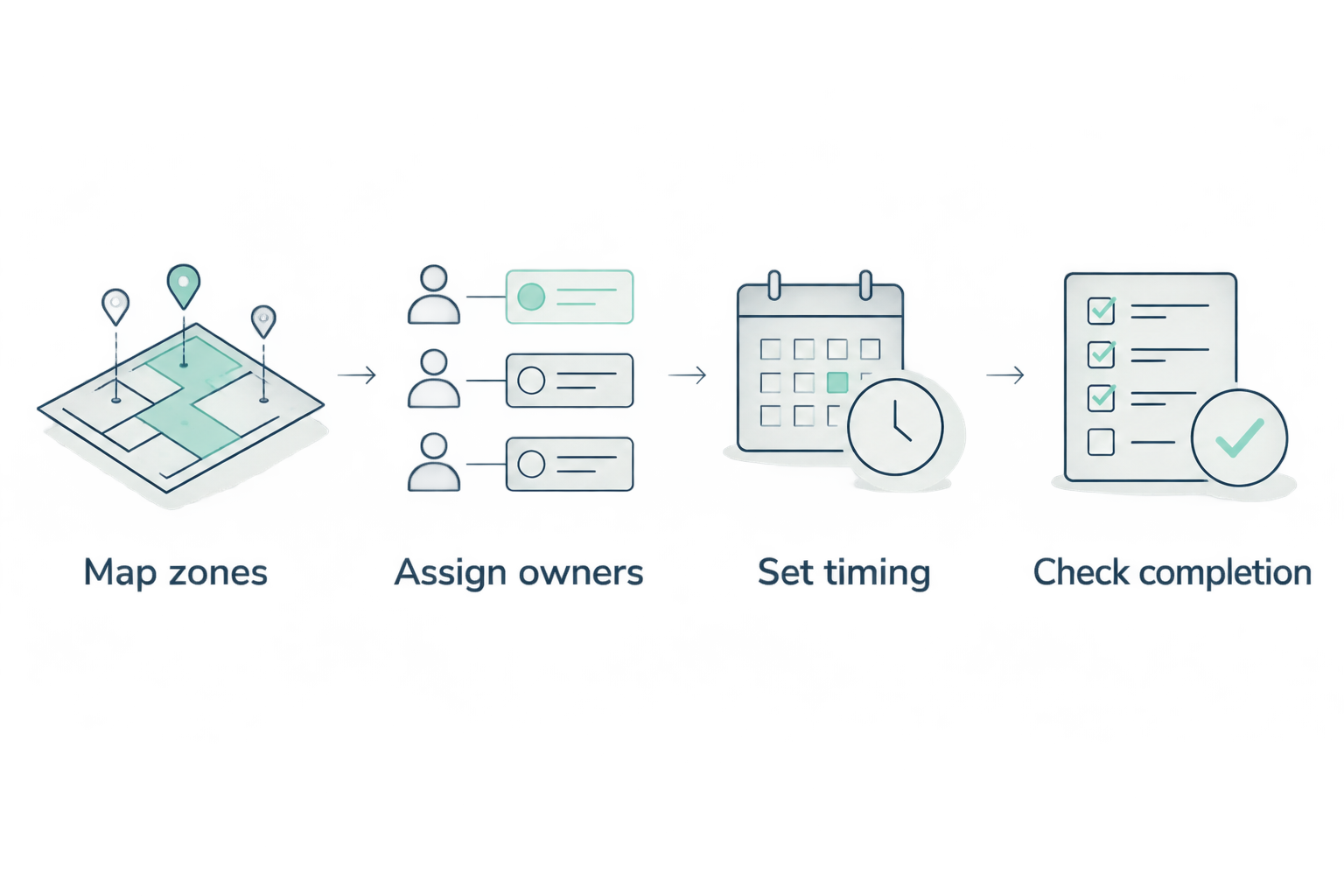
Agree on responsibility and timing before asking someone to sign off the work.
Use 2 walkthroughs per trading day as a starting routine: one before opening and one at closing. Add checks during trading hours wherever store conditions require them; the starting routine is not a substitute for responding to spills or other immediate issues.
Prepare your store before requesting cleaning
Give Pureandcleancleaning a description of your retail space and the tasks you want to discuss. Include flooring types, restroom access, fitting rooms, stockroom boundaries, and the hours when work can take place.
For commercial cleaning services in Tacoma, identify who handles merchandise, keys, access instructions, and the final walkthrough. Ask about team preparation and task instructions rather than assuming a particular training program or credential.
For house cleaning in Tacoma, use the same planning discipline with different spaces: identify rooms, surfaces, personal belongings, pets, and access arrangements. A home checklist and a retail checklist need equally clear instructions, but they should not share an identical scope.
Plan your Tacoma cleaning
Describe your property, cleaning priorities, and preferred schedule.
How these checklist items are ranked
This 2026 ranking follows customer routes first, then shared facilities, specialized spaces, and periodic detail work. Each item is assessed against visibility, surface suitability, ownership, timing, verification, and scope boundaries.
The order is a planning framework, not a claim about measured cleaning results. A store without fitting rooms should remove that entry; a store with heavily used restrooms should move restroom checks higher.
Which checklist should you choose?
Start with entrance and sales-floor care, then add checkout cleaning and restroom care where applicable. Build out the remaining tasks around your actual layout rather than copying every entry unchanged.
Keep your 2026 version short enough to use during a shift. To discuss an agreed residential or commercial scope with Pureandcleancleaning, request a quote with your property details and priorities.
FAQ
What's the best cleaning checklist for Tacoma retail stores?
The best starting checklist covers entrances, sales floors, checkout surfaces, restrooms, fitting rooms where present, staff areas, waste, and scheduled detail work. Give every task an owner, timing, and a completion check.
How often should a retail store check its cleaning?
Start with opening and closing walkthroughs, then add checks during trading hours according to conditions. Respond to spills and other immediate issues when they occur rather than waiting for the next scheduled walkthrough.
Should employees or a cleaning company handle the checklist?
Divide responsibility explicitly between store employees and the contracted cleaning team. Identify who handles trading-hour upkeep, merchandise, scheduled cleaning, and completion checks before work begins.
Can the same checklist work for house cleaning and retail cleaning?
Use the same planning format, but not the same task list. Homes need room-specific instructions, while retail stores need customer-route checks, merchandise boundaries, and coordination with trading hours.
Does commercial cleaning include payment terminals and display cases?
Confirm payment terminals and display cases individually in the agreed scope. Device instructions, surface materials, merchandise, and access determine the appropriate method and responsibility.
What should I move before cleaners arrive at my store?
Clear the agreed work areas of merchandise, personal belongings, and documents that prevent access. Confirm who moves displays or fixtures rather than assuming the cleaning team will move them.
How do I request retail cleaning from Pureandcleancleaning?
Submit a quote request describing your Tacoma premises, requested tasks, access arrangements, and preferred schedule. Ask which checklist items can be included and confirm responsibilities before booking.
One last thing
Add an exception note beside each completion check. A checked box cannot tell you whether a locked room, blocked shelf, or damaged fixture prevented the work; a brief note gives the next person a clear action.