
Best overall: restroom checks. Best for shared spaces: kitchen and breakroom cleaning. Best starting point: entrance and floor care. This 2026 guide ranks the best janitorial checklist items Seattle businesses should put in writing before booking. Pureandcleancleaning provides residential house cleaning and commercial janitorial services in Seattle, Tacoma, and Pierce County; the checklist below helps you define the work your space needs.
TL;DR
The best janitorial checklist Seattle businesses can use starts with restrooms, shared kitchens, and entrance floors.
Pureandcleancleaning provides residential and commercial cleaning; confirm specific tasks before booking.
Give every checklist task a location, schedule, and completion standard.
Keep house cleaning Tacoma and commercial cleaning services Tacoma checklists separate, even when tasks overlap.
Why this matters
A cleaning checklist should describe work, not just name rooms. “Clean the office” leaves unanswered questions about desks, bins, floors, shared appliances, and locked spaces.
Start with the rooms people use, then assign specific tasks and boundaries. Review the available cleaning services against your list rather than assuming every task belongs in every visit. The same approach works at home: a kitchen counter, an oven interior, and a cabinet interior are separate requests.
What makes the best janitorial checklist
Use these criteria to evaluate your 2026 cleaning plan before choosing tasks:
Clear scope: Name the surface, room, or fixture instead of writing “general cleaning.”
Visible completion: Describe an observable result, such as an emptied bin with its liner replaced when required.
Assigned responsibility: State what cleaners handle and what employees or household members prepare.
Suitable scheduling: Connect tasks to room use, access, and your agreed service schedule.
Surface instructions: Identify materials, care requirements, and areas that need special handling.
Explicit exclusions: Record work that requires a separate request or falls outside the agreed scope.
A useful checklist tells you what happens, where it happens, and how you confirm completion. Keep those details together so instructions do not depend on someone remembering a conversation.
Janitorial checklist priorities at a glance
These 7 task areas provide a practical starting order for a 2026 checklist. Change the order when your premises have different priorities; this is a planning framework, not a claim that every building needs the same service.
1. Restroom checks
Best for: Shared restroom accountability
Standout feature: Separates fixtures, floors, bins, and supplies
Key limitation: Supply purchasing needs its own agreement
2. Kitchen and breakroom cleaning
Best for: Shared food spaces
Standout feature: Distinguishes surfaces from appliance interiors
Key limitation: Personal dishes need an assigned owner
3. Entrance and floor care
Best for: Tracking room-by-room floor work
Standout feature: Connects floor tasks to surface instructions
Key limitation: One method does not fit every material
4. Frequently handled surfaces
Best for: Naming easily overlooked touchpoints
Standout feature: Lists handles, switches, and shared controls
Key limitation: Cleaning is not automatically disinfection
5. Waste and recycling
Best for: Clear collection responsibilities
Standout feature: Identifies bins and disposal locations
Key limitation: Unusual waste needs separate instructions
6. Desks and shared workspaces
Best for: Protecting work boundaries
Standout feature: Defines clear surfaces and no-touch areas
Key limitation: Clutter restricts access
7. Detail checks and handoff
Best for: Following up on incomplete work
Standout feature: Records exceptions and periodic tasks
Key limitation: A checklist still needs an owner
1. Restroom checks: best for shared restroom accountability
Restroom instructions should name toilets, sinks, counters, mirrors, floors, and waste bins individually. Keep checking consumables separate from supplying them; neither responsibility should be assumed.
For a household bathroom, use the same fixture-by-fixture approach. Identify shower glass, tub surfaces, personal toiletries, and storage areas separately so the requested work is clear.
Restroom-check pros:
Makes missed fixtures easier to identify.
Separates cleaning from restocking responsibilities.
Gives shared and private bathrooms distinct instructions.
Restroom-check cons:
Requires access to each room.
Does not establish who purchases consumables.
Best for: Offices, businesses, and households that need clear bathroom responsibilities.
Before service, report a leaking fixture or blocked drain rather than putting repair work on a cleaning checklist. Keep maintenance requests separate from cleaning instructions.
Verdict: Hold any plan that leaves restroom fixtures or supply responsibilities undefined.
2. Kitchen and breakroom cleaning: best for shared food spaces
List counters, sinks, tables, appliance exteriors, and floors as separate tasks. Ask specifically about microwave, refrigerator, or oven interiors instead of treating “kitchen cleaning” as permission to empty and clean everything.
At home, identify dishes, food containers, and small appliances that you will move before the visit. In a workplace, decide who handles employee food and personal mugs.
Kitchen-checklist pros:
Distinguishes accessible surfaces from storage interiors.
Sets boundaries around food and personal belongings.
Helps you prepare counters before service.
Kitchen-checklist cons:
Requires decisions about abandoned food.
Does not assign dishwashing unless you add it.
Best for: Shared breakrooms and household kitchens with several users.
Write appliance instructions beside the appliance task. A note elsewhere in an email is easier to miss when someone is checking the room.
Verdict: Skip catch-all kitchen instructions; name surfaces and interiors separately.
3. Entrance and floor care: best for room-by-room floor planning
Break floor care into entrances, corridors, work areas, kitchens, and restrooms. Record the floor material and relevant care instructions before agreeing on cleaning methods.
For a home, distinguish entry flooring, rugs, stairs, and rooms with furniture that limits access. For a business, identify reception areas and spaces that remain occupied during service.
Floor-checklist pros:
Makes different surface requirements visible.
Defines which rooms and routes are included.
Connects preparation to accessible floor space.
Floor-checklist cons:
Requires accurate material information.
Does not automatically include furniture moving or specialty treatments.
Best for: Properties with several floor types or restricted-access rooms.
State where movable items should go and who moves them. Do not assume cleaners will relocate heavy furniture, equipment, or stored inventory.
Verdict: Hold floor-care instructions until material requirements and access are clear.
4. Frequently handled surfaces: best for naming missed touchpoints
Replace “wipe common areas” with a location-specific list: door handles, light switches, reception counters, and shared controls where appropriate. Check manufacturer instructions before adding electronics or sensitive equipment.
A household version can identify cabinet pulls, stair rails, and other agreed surfaces. Keep personal devices outside the scope unless their handling is expressly agreed.
Touchpoint-checklist pros:
Names small surfaces that broad room labels miss.
Separates shared fixtures from personal equipment.
Makes exclusions easy to communicate.
Touchpoint-checklist cons:
Needs surface-specific instructions.
Does not make cleaning and disinfection interchangeable.
Best for: Shared offices and homes where small, frequently handled surfaces need explicit attention.
If disinfection is requested, confirm the product, suitable surfaces, and label directions. Do not describe an ordinary wipe-down as a verified health outcome.
Verdict: Skip vague touchpoint promises; specify the surfaces and requested process.
5. Waste and recycling: best for clear collection responsibilities
List each collection point, the intended waste stream, and the agreed destination. Add instructions for liners, containers that should remain untouched, and anything outside ordinary collection.
At home, distinguish bathroom bins, kitchen waste, and recycling. At work, identify desk bins, shared stations, and any containers employees manage themselves.
Waste-checklist pros:
Reduces ambiguity about which bins are included.
Establishes where collected material goes.
Separates ordinary collection from unusual waste.
Waste-checklist cons:
Requires current disposal instructions.
Does not cover confidential or specialized waste without agreement.
Best for: Properties with multiple collection points or different responsibilities by room.
Confirm access to the collection destination before service. A full bin and an inaccessible disposal area are different issues and should be recorded differently.
Verdict: Hold collection instructions that omit disposal locations or excluded materials.
6. Desks and shared workspaces: best for protecting work boundaries
Specify which clear surfaces are included and which items must not be moved. Separate shared tables from individual desks, paperwork, monitors, and other equipment.
For residential cleaning, apply the same rule to home offices, study tables, and bedside surfaces. Put private documents and fragile belongings away before the visit rather than relying on an unwritten understanding.
Workspace-checklist pros:
Establishes no-touch areas.
Makes preparation responsibilities clear.
Distinguishes furniture surfaces from equipment.
Workspace-checklist cons:
Depends on accessible surfaces.
Does not include organizing documents or belongings by default.
Best for: Offices and households with paperwork, electronics, or personal items near cleaning areas.
Ask how blocked surfaces will be recorded. “Not accessible” is a more useful handoff note than an unexplained unchecked box.
Verdict: Skip instructions that require guessing what can be moved.
7. Detail checks and handoff: best for following up on incomplete work
Keep periodic tasks separate from the regular visit list. Name details such as baseboards, interior glass, or other agreed work without implying that every service includes them.
Use a closing check for both homes and workplaces: note completed tasks, inaccessible areas, and issues needing the property owner's attention. Give someone responsibility for reviewing those notes.
Handoff-checklist pros:
Keeps exceptions visible.
Separates periodic work from routine tasks.
Gives follow-up requests a clear owner.
Handoff-checklist cons:
Requires someone to review the record.
Cannot replace an agreed service scope.
Best for: Recurring cleaning arrangements where instructions need to stay current.
Describe the issue precisely. “Meeting-room table blocked by equipment” gives you a next step; “room incomplete” does not.
Verdict: Hold checklist approval until someone owns the follow-up.
Turn the list into a usable cleaning plan
Use 3 fields per task: location, schedule, and completion standard. For example, a breakroom-bin entry should identify the bin, its agreed collection schedule, and what completion includes.
Then follow this sequence:
Walk through: List rooms, surfaces, and access restrictions.
Set scope: Agree on included tasks, exclusions, and preparation.
Assign schedules: Separate regular visits from periodic requests.
Review completion: Record exceptions and update instructions.
Keep the approved version where the person coordinating service can find it. If several people request changes, route those changes through one named contact instead of keeping conflicting lists.
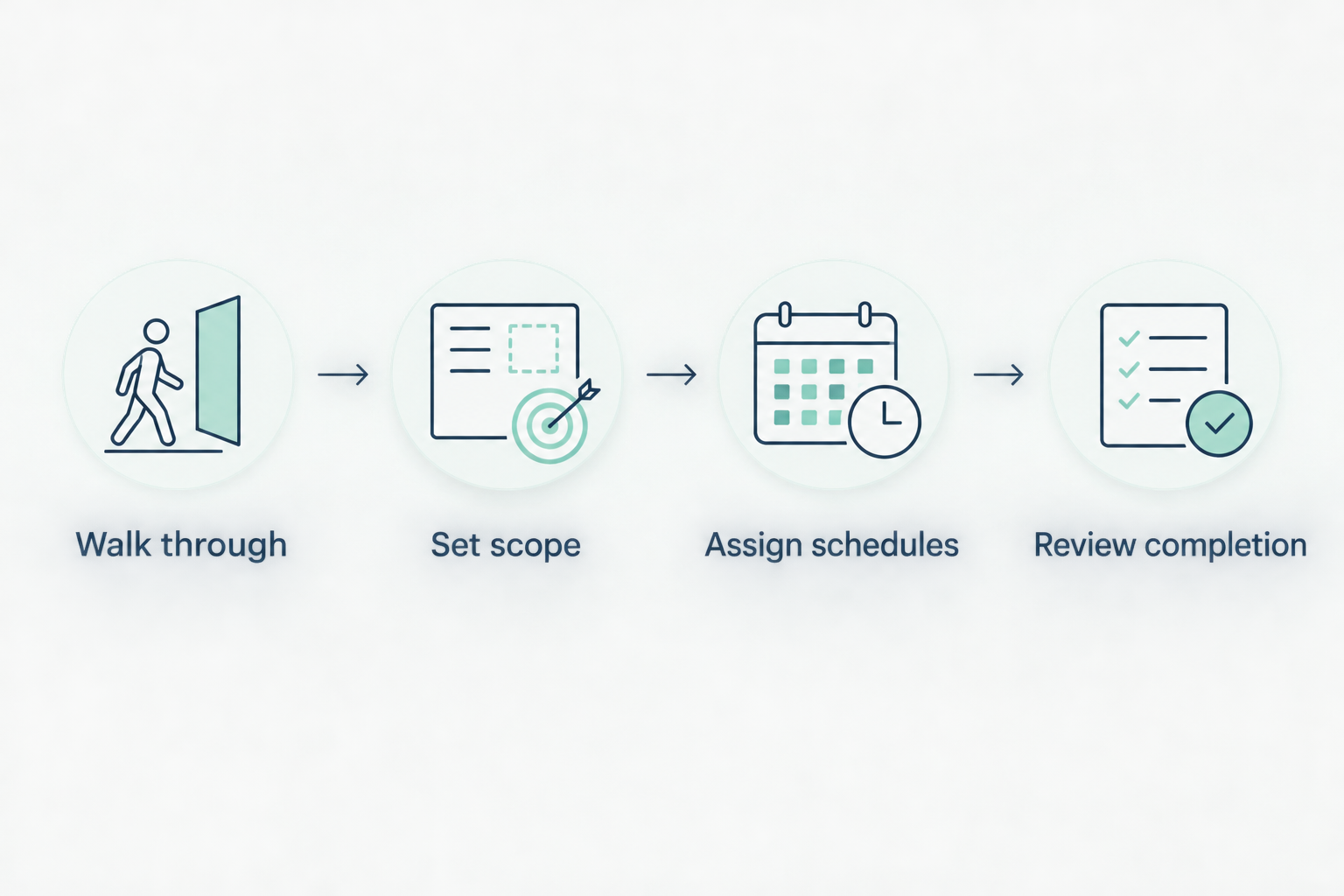
Agree on scope and scheduling before using the checklist to review completion.
Prepare 2 schedules if you manage both a home and a business. Household routines and workplace access belong in separate documents, even when the underlying tasks overlap.
Adapt the checklist for Tacoma homes and businesses
For house cleaning Tacoma requests in 2026, describe the rooms you want cleaned, the surfaces needing attention, and any belongings you will put away. Identify bathroom fixtures, kitchen surfaces, floor materials, and rooms that should remain closed. Ask which requested details fit the service before booking.
For commercial cleaning services Tacoma requests, provide the business address, room types, access arrangements, and preferred service windows. Identify shared facilities, employee-managed areas, and who approves changes. Ask how the proposed work will account for occupied spaces and restricted rooms.
Give residential and commercial requests the same level of detail. Neither “a standard house clean” nor “normal office cleaning” defines a complete scope. A written room list gives both conversations a useful starting point.
Pureandcleancleaning's residential and commercial cleaning services cover homes and businesses; use your checklist to explain the work you want, then confirm the agreed details directly.
How these checklist items are ranked
Restrooms come first because they combine several responsibilities in one room: fixtures, floors, waste, and supplies. Kitchens follow because shared surfaces, food, and appliance interiors need separate instructions.
The remaining items organize floor care, small surfaces, collection, personal work areas, and follow-up. The ranking reflects the scope and accountability criteria above—not a service test, inspection score, or promise of results.
Which checklist should you choose?
Choose a room-by-room checklist with task-level instructions, not a generic building-wide tick box. Start with the 7 areas above, remove anything irrelevant, and mark additional requests for discussion.
Pureandcleancleaning is a residential and commercial cleaning option for homeowners and business decision-makers in Seattle, Tacoma, and Pierce County. Use the request-a-quote page to describe your property and requested work, then confirm scope, preparation, and scheduling before booking.
Request cleaning for your property
Describe your home or business, requested tasks, and preferred schedule.
FAQ
What's the best janitorial checklist for a Seattle business?
The best starting checklist names restrooms, kitchens, floors, frequently handled surfaces, waste, workspaces, and completion checks. Adapt each task to your premises and confirm the service scope before booking.
Should every cleaning task happen on every visit?
No; assign each task an agreed schedule based on the space and requested work. Keep regular visits and periodic detail requests separate so neither is mistaken for the other.
What should employees do before office cleaning?
Employees should follow the agreed preparation instructions, including clearing designated surfaces and securing personal or confidential items. Confirm who handles dishes, food, equipment, and any items blocking access.
Can I use an office checklist for house cleaning in Tacoma?
Use the same task-level format, but create a separate household checklist. Replace workplace areas with your home's rooms and identify personal belongings, pets, access instructions, and requested details.
Does janitorial cleaning automatically include disinfection?
No; confirm disinfection as a specific requested process rather than assuming it is part of every cleaning task. Suitable surfaces, products, and label directions must be addressed separately.
Does Pureandcleancleaning serve both homes and businesses?
Pureandcleancleaning provides residential house cleaning and commercial janitorial services in Tacoma, Seattle, and Pierce County, Washington. Describe your property and requested tasks when contacting the business to confirm the scope.
What should I include when requesting commercial cleaning services in Tacoma?
Include your property location, room types, requested tasks, access arrangements, and preferred service windows. Identify restricted areas and any work that requires separate discussion before scheduling.
One last thing
Add an “unable to complete” field to your 2026 checklist. A locked room, blocked surface, or unclear instruction needs a reason and a next step—not a misleading completion mark. That small change makes the checklist useful after the visit as well as before it.