
Best overall: a phased, whole-property checklist. Best for an occupied home: a room-by-room checklist. Best for a self-managed cleanup: a finish-protection checklist. For Tacoma homes in 2026, choose the approach that matches the work completed, then confirm who handles construction debris, settled dust, and the final handover.
TL;DR
The best post-renovation cleaning checklist Tacoma homes need separates construction cleanup, detailed cleaning, and final inspection.
Use a room-by-room checklist when you need to keep part of your home usable.
Use an occupancy-readiness checklist for offices, shared spaces, and business handovers.
Pureandcleancleaning provides residential and commercial cleaning; confirm post-renovation tasks before booking.
Why this matters
A renovation handover needs more detail than a routine cleaning list. Dust on trim, residue on a new surface, and debris left by a contractor require different decisions. Treating everything as ordinary dirt skips the question that matters first: who is responsible for each task?
Pureandcleancleaning provides house cleaning and commercial janitorial services in Tacoma, Seattle, and Pierce County. Review the cleaning services when planning your handover, and describe the renovation before requesting a booking. Do not assume a routine cleaning appointment includes construction cleanup.
The same distinction matters for businesses. A homeowner needs rooms ready for daily use; a business decision-maker also needs clear access arrangements, protected equipment, and an agreed reopening handover.
What makes the best post-renovation cleaning checklist?
Judge a checklist by its instructions, not its length. These criteria apply equally to a remodeled home and a renovated workplace:
Clear scope: Names the rooms, surfaces, and exclusions rather than saying everything will be cleaned.
Correct sequence: Separates contractor work, detailed cleaning, and inspection.
Finish protection: Requires care instructions before cleaning newly installed materials.
Access planning: Explains how occupants, pets, staff, and deliveries affect the appointment.
Named responsibility: Assigns debris removal, specialist work, and sign-off to the appropriate person.
Documented handover: Records unresolved marks, damage, and unfinished work without treating them as cleaning failures.
For your 2026 renovation, keep scope and responsibility in writing. A checklist cannot settle a disagreement if the contractor and cleaner have different versions.
Post-renovation checklists at a glance
These are ranked planning approaches, not different service packages. Combine them when your property needs more than one.
1. Phased whole-property
Best for: Completed renovations needing a full handover
Standout feature: Separates cleanup into clear stages
Key limitation: Requires coordination with remaining trades
2. Room-by-room
Best for: Occupied homes
Standout feature: Tracks rooms separately
Key limitation: Shared hallways can carry dust between areas
3. Finish-protection
Best for: Newly installed or delicate materials
Standout feature: Puts care instructions before cleaning methods
Key limitation: Does not replace a complete property checklist
4. Occupancy-readiness
Best for: Offices and commercial premises
Standout feature: Connects cleaning scope with reopening tasks
Key limitation: Requires input from the business and contractor
5. Final-detail
Best for: Walkthroughs after main cleaning
Standout feature: Captures missed details and unresolved issues
Key limitation: Cannot replace debris removal or detailed cleaning
1. Phased whole-property: best for a complete handover
The phased checklist organizes the job around readiness rather than individual rooms. Use 3 passes: contractor handover, detailed cleaning, and final inspection. These are planning stages, not a promise that every property needs the same number of visits.
Start by confirming that dust-producing work has ended. Then establish which accessible surfaces belong in the cleaning scope and who will inspect the result.
Phased checklist:
Contractor handover: confirm debris responsibility, unfinished work, and access restrictions.
Detailed cleaning: list agreed ledges, trim, doors, reachable fixtures, cupboards, and floors.
Final inspection: record missed areas separately from damage or unfinished installation.
Phased checklist pros:
Gives the homeowner or business manager a clear sequence.
Makes responsibility easier to assign.
Keeps the walkthrough separate from active construction.
Phased checklist cons:
Depends on accurate updates from trades.
Needs revision when construction continues after cleaning.
Best for: A finished renovation involving several connected spaces.
Verdict: Use this as your default checklist.
2. Room-by-room: best for an occupied home
A room-by-room checklist tracks completed spaces while your household continues using the property. Start with 1 room and agree on its boundaries before treating it as ready for normal use. Include the route people take through shared areas.
List tasks by room rather than copying one identical list throughout the home. A kitchen needs different scope questions from a bedroom; a home office also needs decisions about electronics and paperwork.
Room-by-room checklist:
Kitchen: agree on counters, cabinet fronts, handles, appliance exteriors, and accessible interiors.
Bathroom: identify fixtures, mirrors, cabinetry, and manufacturer restrictions on new finishes.
Living areas: list trim, doors, ledges, accessible fixtures, and flooring.
Shared routes: identify entrances, stairs, and hallways used by occupants or contractors.
Room-by-room checklist pros:
Makes household priorities explicit.
Helps you track completed and unfinished areas.
Supports a clear discussion about access.
Room-by-room checklist cons:
Does not isolate dust by itself.
Can overlook shared routes if they are not listed separately.
Best for: Homeowners staying in the property during a staged renovation.
Verdict: Use for occupied homes; skip treating each room as independent.
3. Finish-protection: best for newly installed materials
A finish-protection checklist starts with the surface, not the cleaning product. Collect the manufacturer's care instructions for new flooring, counters, cabinetry, glass, and fixtures. Ask the installer to identify any restrictions before cleaning begins.
Keep labels or care documents accessible. Do not ask a cleaner to guess whether an unidentified mark is dust, adhesive, paint, or damage.
Finish-protection checklist:
Identify the material and its care instructions.
Record installation-related cleaning restrictions.
Flag paint, adhesive, grout haze, and other residue for scope confirmation.
Refer uncertain marks to the installer before treatment.
Finish-protection checklist pros:
Gives the cleaning team specific instructions.
Separates ordinary dust from installation residue.
Makes unresolved marks easier to discuss with the contractor.
Finish-protection checklist cons:
Relies on accurate material information.
Does not establish whole-property coverage or scheduling.
Best for: Homeowners and businesses protecting newly installed finishes.
Verdict: Use alongside another checklist, not as your only plan.
4. Occupancy-readiness: best for commercial reopening
An occupancy-readiness checklist connects cleaning with the business handover. It distinguishes the areas a cleaning team can access from tasks controlled by the contractor, property manager, or business owner. Cleaning completion alone does not establish that a workplace is ready to reopen.
For commercial cleaning services in Tacoma, name the decision-maker who can approve access and resolve scope questions. In a home-based business, apply the same approach to workspaces without losing sight of household needs.
Occupancy-readiness checklist:
Work areas: identify cleared desks, accessible surfaces, and equipment exclusions.
Shared facilities: list reception areas, break rooms, restrooms, and meeting rooms.
Access: confirm keys, entry instructions, alarms, and restricted spaces.
Handover: assign cleaning sign-off separately from construction or operational approval.
Occupancy-readiness checklist pros:
Gives business managers a practical coordination tool.
Makes equipment and document boundaries explicit.
Separates cleaning approval from reopening decisions.
Occupancy-readiness checklist cons:
Requires information from several responsible parties.
Does not replace inspections or contractor sign-off.
Best for: Offices and other business premises preparing for occupancy.
Verdict: Use for commercial handovers, with a named business contact.
5. Final-detail: best for the last walkthrough
The final-detail checklist checks agreed work after the main cleanup. Walk through with the scope beside you and note specific locations rather than reporting that a room still looks unfinished. Keep cleaning corrections separate from construction defects.
Check surfaces in available lighting, including corners and edges that are easy to overlook. Avoid moving heavy furnishings or opening restricted equipment simply to complete a checklist.
Final-detail checklist:
Check agreed ledges, door edges, trim, and reachable surfaces.
Review floors, corners, and transitions between rooms.
Record the location and appearance of unresolved marks.
Confirm who owns each remaining action.
Final-detail checklist pros:
Turns vague concerns into specific tasks.
Creates a clear closing discussion.
Works for both residential and commercial spaces.
Final-detail checklist cons:
Comes too late to fix poor access planning.
Cannot substitute for the main cleaning stage.
Best for: Homeowners and business contacts signing off agreed cleaning work.
Verdict: Use at the end; skip it as a standalone cleanup plan.
Prepare the space before cleaning begins
For a 2026 handover, prepare 2 lists: rooms included and tasks excluded. Share both with the contractor and proposed cleaning provider. Resolve differences before agreeing to the appointment.
For a home, remove personal belongings from surfaces included in the scope. Explain pet arrangements, identify rooms still in use, and leave material-care instructions where the team can find them. Do not move construction waste or unidentified materials just to make the property look ready.
For a business, preparing for post-renovation cleaning means resolving access, equipment boundaries, and contractor responsibilities before cleaners arrive. Assign a contact who can answer questions about locked rooms, documents, and unfinished work.
Use this preparation sequence for either setting:
Confirm completion: Ask the contractor what work remains.
Define scope: Name the included rooms and surfaces.
Clear access: Make agreed areas accessible without disturbing restricted materials.
Share instructions: Provide finish-care and entry details.
Assign sign-off: Choose who checks the completed scope.
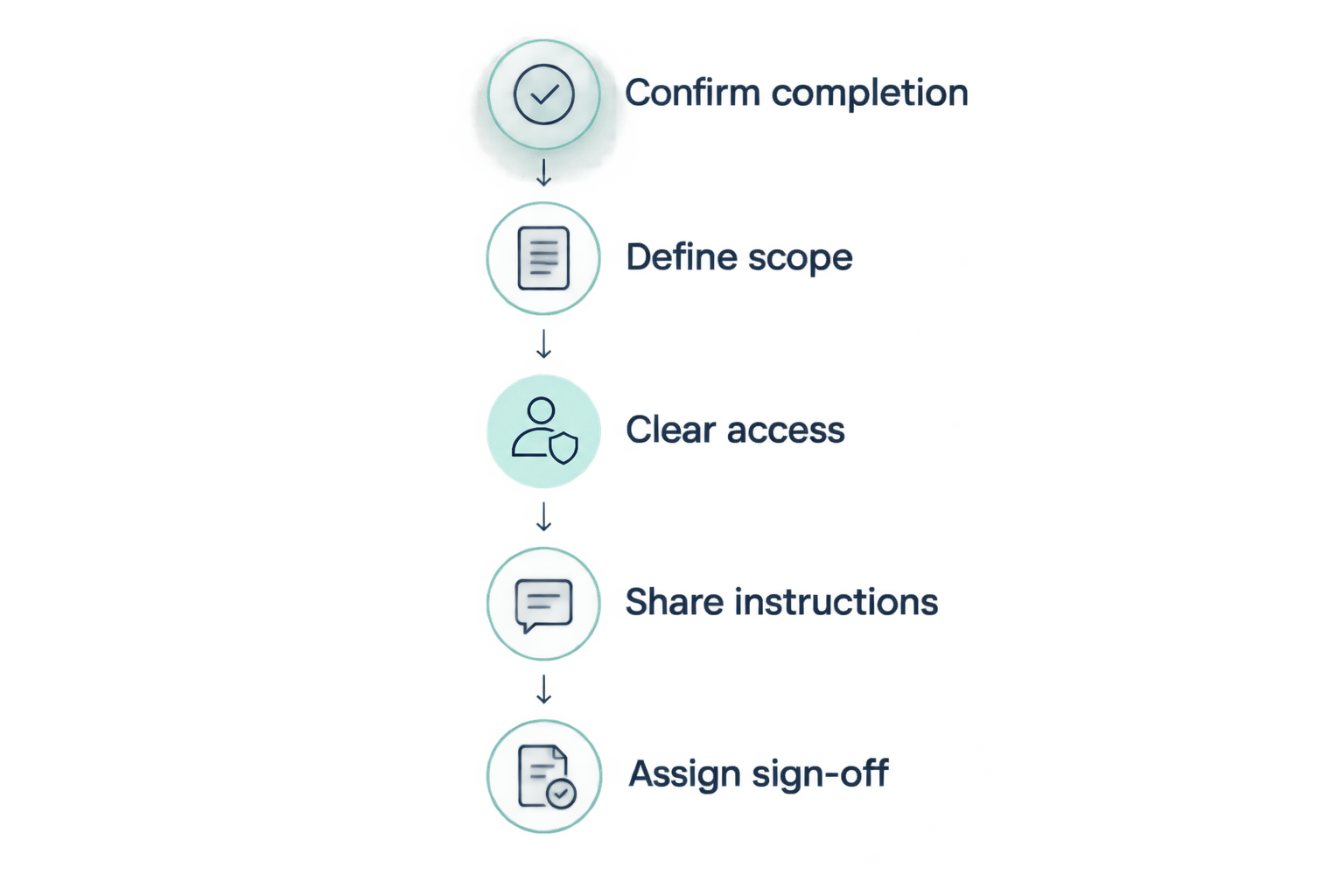
Resolve scope and access before the cleaning appointment.
A clear handover also separates ordinary cleaning from work that needs specialist assessment. Tell the provider about visible construction residue and unidentified materials before booking; do not describe the job only as a deep clean.
Choose a schedule around remaining work
Do not choose the cleaning date independently of the renovation schedule. Ask whether cutting, sanding, painting, installation, or deliveries will continue in the areas being cleaned. If work remains, agree which rooms can genuinely be handed over.
At home, account for the rooms you need that evening and the routes your household will use. In commercial premises, identify staff access, deliveries, and equipment installation that overlap with the proposed cleaning window. Share these constraints rather than assuming the team can work around them.
For a 2026 booking with Pureandcleancleaning, describe the property, renovation work, affected rooms, and requested tasks when you request a quote. Ask whether the post-renovation scope is suitable before treating the appointment as confirmed.
Discuss your cleaning scope
Describe your home or business, renovation work, and the areas you need cleaned.
How these checklists are ranked
The phased checklist ranks first because it covers sequence, responsibility, and inspection. The remaining options address narrower decisions: living through renovation, protecting finishes, preparing business premises, and checking completed work.
This ranking compares planning approaches, not measured cleaning results. Choose the approach that answers your handover problem, then add the relevant supporting checklist.
Which checklist should you choose?
Choose the phased whole-property checklist unless your renovation is limited to a clearly separated space. Add finish-protection instructions wherever new materials need specific care, and finish with a documented walkthrough.
Pureandcleancleaning is a fit for Tacoma homeowners and businesses seeking residential or commercial cleaning; confirm renovation-specific scope before booking. For house cleaning in Tacoma, describe how your household uses the space. For commercial cleaning services in Tacoma, identify the business contact and access requirements.
FAQ
What's the best post-renovation cleaning checklist for Tacoma homes?
A phased whole-property checklist is the best default because it separates contractor handover, detailed cleaning, and final inspection. Add room-specific tasks and care instructions for newly installed materials.
Should I book ordinary house cleaning after a renovation?
Describe the renovation before booking rather than assuming ordinary house cleaning covers the work. Confirm construction debris, settled dust, surface residue, and accessible interiors separately.
When should post-renovation cleaning be scheduled?
Schedule cleaning around the completion of dust-producing work in the areas being handed over. Tell the provider about remaining trades, deliveries, and rooms that are still occupied.
What should I do before cleaners arrive at my renovated home?
Clear agreed surfaces, explain access and pet arrangements, and provide care instructions for new materials. Confirm who handles construction waste and unfinished work before the appointment.
How does a commercial renovation cleaning checklist differ?
A commercial checklist adds business access, equipment boundaries, shared facilities, and a named handover contact. Keep cleaning sign-off separate from construction approval and reopening decisions.
Does post-renovation cleaning include paint or adhesive removal?
Do not assume paint or adhesive removal is included. Identify the surface and residue, then ask the provider and installer what treatment is appropriate and who is responsible.
What should I include when requesting a cleaning quote?
Include the property location, renovation type, affected rooms, remaining work, and requested cleaning tasks. Describe access restrictions and new finishes so the provider can assess the scope.
One last thing
For your 2026 walkthrough, photograph unresolved marks before anyone attempts further treatment. A photo records where the issue is; it does not establish whether the cause is dirt, damage, or unfinished installation. Assign that question to the appropriate contractor or provider instead of repeatedly cleaning an unidentified mark.